Showing posts with label raw. Show all posts

Tuesday, November 15, 2011

Leaving Ghana and "How It Was"

Somehow, leaving Ghana was less painful than anticipated. I was ready for my next chapter. I left knowing I will return some day, and Ghana will be waiting with welcoming arms. 

Leaving the Ghanaians I had grown close to however, well, that was the most difficult thing I've ever had to do. I was bursting into sporadic fits of tears the entire week before my departure. Sometimes a mere glance from a Ghanaian friend - a stranger, even - would cause me terrible distress. I sobbed the entire second half of the last drumming and dance performance of the cultural group that had become my brothers and sisters. If that wasn't theatric enough, I left the performance early - ran up the stage's steps (dramatically, the only exit), past the Cape Coast Slave Castle and into the night, raw as an open wound.

What saddened me most was the idea that every relationship I made in Ghana would never again be as I know it now. When I return to Ghana we will all have changed. I'm not opposed to change, but the concept of "how it was" is sacred to me. Leaving my Ghanaian community was like waking up too soon from a good dream. You have the mental power, the imagination to finish it however you want, but you would rather find the happy ending by returning to the dream. You go back to sleep and try to continue the good dream, but you can't. 

"How it was" has reshaped me, and now it will be only a memory.

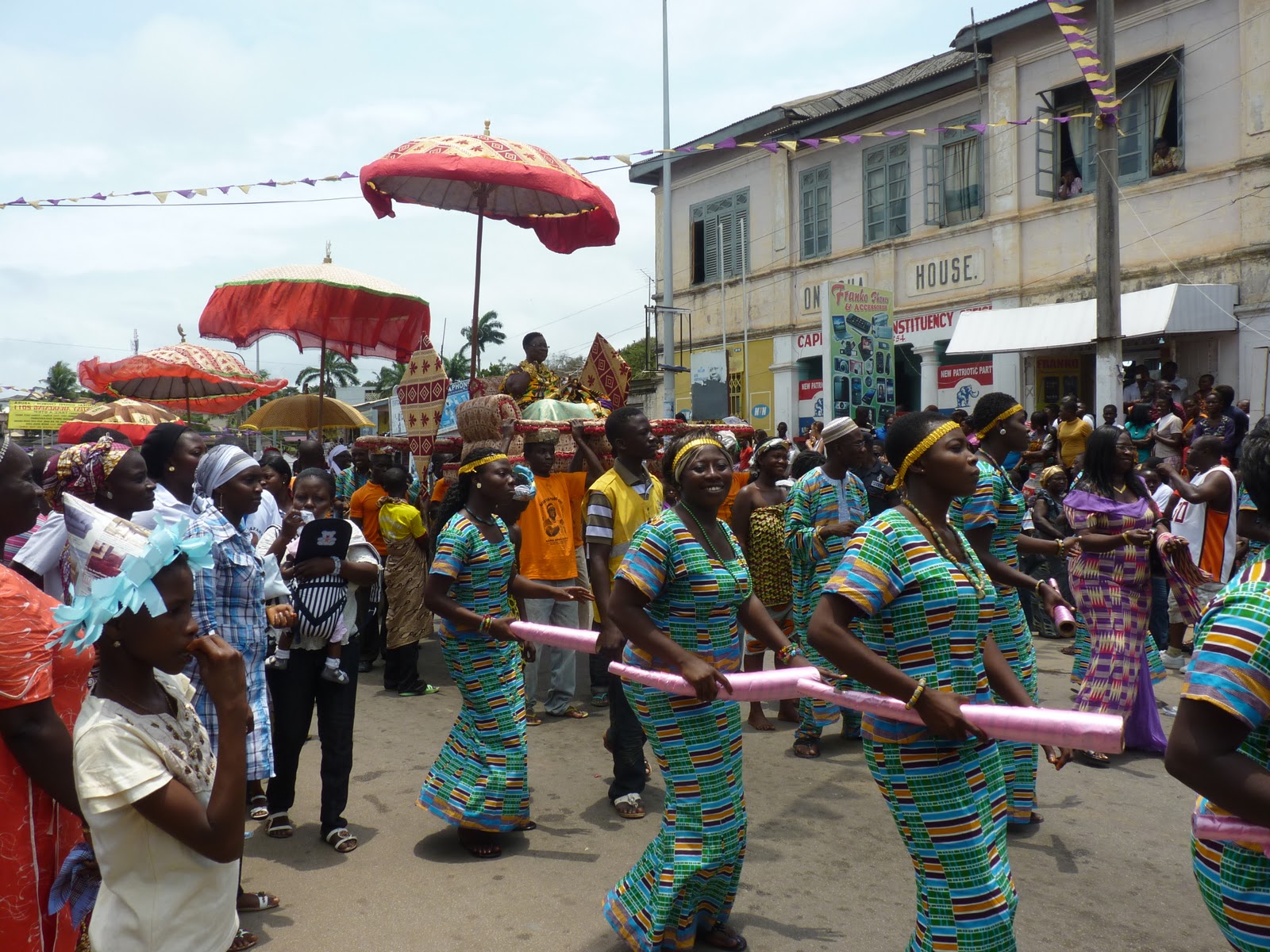
After completing my work in Ghana in September 2011, I finished my 14-month adventure in Cape Coast with the annual "Oguaa Fetu Afahye," or Cape Coast Festival.


Before I left Ghana I learned the organization I worked for was planning to open a site in Cape Town, South Africa. I offered to help set up the site, knowing that I would be visiting the country anyway. So, in September and October I spent a weekend in Johannesburg, a week in Durban, a week around Mbabane, Swaziland (and was stranded there because of the public transportation drivers' riots), and four weeks in Cape Town.

In Cape Town I was contracted by my former employer to meet with local businesses to lay the foundation for the new nongovernmental organization office. I met with over one dozen community partners and set up the projects, accommodation and excursions. The site officially opens in January 2012. It was such a cool experience to network and search for potential business partners in Cape Town and hear about what these innovative enterprises do.

I fell in love with Cape Town, Durban and South Africa's complicated social and political history. Swaziland was also a fascinating country with interesting political history, being the last absolute monarchy in the southern hemisphere. I would love to return some day and spend more time there.

Update:  I actually did end up returning to Swaziland two months after this post. I was hired by a responsible tourism company and lived and worked there for about one year. 

Sunday, August 14, 2011

Summer of Silence

This is the first summer I can remember that has left me more stressed, more anxious and more exhausted than before it started. Our site has led and accommodated between 20 and 50 volunteers each month from May through August, including four study abroad group programs. With the Project Coordinator Intern's angelic assistance, I have managed all individual volunteer and intern projects and group projects – the miscommunications, the questions, the complaints and the positive feedback from the local project partners, volunteers, interns and faculty leaders. I also approved funding applications and distributed the funds for all these projects (5 projects in May, 12 in June, 17 in July; 9 in August). It was a lot of administrative work and a lot more of putting out fires.

Of the 10 country sites our international nongovernmental organization operates within, the Ghana site was expected to have the most action this summer. After a few months of the Ghana Site Director nagging the President about getting more help on-site, our request was granted in May. Our site grew from four full-time staff members (two local, two foreign) to also include a local temporary Project Coordinator Intern (May-September), a foreign Program Advisor from our marketing department (May-July) and a foreign Volunteer Coordinator (one-year contract). At the end of June, two managers from different departments in our U.S. headquarters office visited for two weeks. It was the first occasion anyone in a managerial position came to our site since it opened in July 2009, a long absence even if the staff hadn’t been stifling complaints about the way things were being managed on-site.

Since mid-May at least once per week there have been personal and professional conflicts among the staff that have resulted in shouting matches, tears and even premeditated public shaming in front of community partners. Somehow I always found myself in the middle, mediating. I’ve been tempted to add to my job description in my resume, "mitigated temper tantrums, nervous breakdowns and verbal attacks between parties."

My blog has been quiet this summer. I assure readers it is not out of laziness. It is because I am tired.

I am emotionally depleted from the 15-hour work days and being on-call 24 hours a day, 7 days a week, approving a volunteer’s ideas for her project money donation at 8 p.m. on a Friday night, being called by a host mother at 10:15 p.m. asking if her “daughter” was at our volunteer house because she hadn’t come home yet and then being woken up at 6:50 a.m. the next morning to a volunteer’s call about a question regarding her host family. It is the nature of the job, yes, but that on top of being the site's unofficial peace-keeper? For project partners, volunteers and staff too? My exhaustion stems from always needing to be available, practical, approachable for others (customers and colleagues) even outside of the regular 8 to 5 work hours. It is one of my personal and professional strengths, but these days and in this particular environment it is wearing me down.

I am also tired because I have so many things to say – about how disheartening it is that young people all over the world come to "the country Africa" to Make A Difference and then get frustrated when they learn that they can’t make a difference in two weeks or even two months because their definition of "help" is different than Ghanaians' definition. (Not all, but most volunteers have this viewpoint - especially the summer batches.) I have more to say about how I don’t like how difficult it is for me to find joy in being a foreigner, always standing out. About how even though I feel safe in Ghana, two lost souls with a gun, a machete and a craving for power shook my core in early June. I hate that I jump and look around when I hear people running now.

A more deep-seeded reason for my silence is because I love Ghana, her people and her culture, and I'm immensely grateful for the experiences I’ve been given. My silence is because I don’t feel like my attitude reflects these feelings right now. I've hardened, I've become jaded and cynical (realistically optimistic?). I don't like it. I hope it doesn't last.

My work contract was from July 2010 to July 2011. In April, before summer bombarded, I made the decision to stay onboard through August 2011 to help with the busy season. After my initial shock of being home in a land of infinite excess and waste and unnatural lights and vanity and refined sugar aromas and mammoth-sized cars and Walmart and who knows what else will toss me off my rocker, I hope I will find peace in the aftermath of this summer.

Tuesday, May 31, 2011

Conversations Over Street Food: Religion, Virginity and Love

I set the alarm on my phone for 2:30 a.m. I would have to recruit a taxi driver from the roadside to pick me up at 3 a.m. from my guesthouse. Hopefully I wouldn’t oversleep and hopefully he wouldn’t be late – I didn’t want to miss the bus to Tamale and be stuck in Kumasi another day.

It was almost 4 p.m. With strained effort I got up from the guesthouse’s soft mattress. My body and mind ached for a nap but I knew I should find some dinner instead and head to bed soon after that.

I left the guesthouse and wandered down the street. Bantama is a suburb of Kumasi, the second largest city in Ghana. This street and the ones branching off it were laden with men. Staring and talking at me in Twi, then laughing to each other about it. I was used to friendlier strangers and felt more like a zoo animal rather than a celebrity, a status I had grown accustomed to (but was still skeptical about) in the past 10 months. From the way they were acting I could’ve assumed I had suddenly grown a ghastly tumor on my face.

I turned right at an intersection in hope of finding Ghanaians who wouldn’t stare, jeer, laugh and point at the obroni. And to find a taxi driver for tomorrow morning. And to buy juice – I was feeling fruit-deprived.

Shortly after the turn I found myself on Bantama’s main drag. Loud music blared from every fifth shop, trinkets from the outdoor market crept from the building to the sidewalk, leaving a walkway wide enough for only two people to pass each other. I maneuvered around the neatly stacked displays of shoes, jewelry, purses, black wigs, fabrics, football (soccer) gear and clothes. I turned into a corner shop and bought a box of pineapple juice.

Then I stood on the side of the road and waved an empty taxi car to my side. Without a word, I got inside. I greeted him and and told him I needed a driver to “pick me” from my guesthouse at 3 a.m. I asked if he would do it and he agreed.

“Where to?”
“Metro Mass Station.”
“You mean the station this way or this way?” he asked, pointing forward and then behind him.
“This way. Metro Mass Station,” I said, pointing behind us. I felt a surge of gratefulness for Isaac, the taxi driver who drove me from the Metro Mass Station to the guesthouse and showed me how close it was.
“Oh, ok,” he said. “And please, where is the guesthouse?”
“I will show you. Drive forward and pass right here.”

I directed him to the guesthouse which was around the corner from where I had gotten into his car. We negotiated a price for the morning fare. He tried charging me 10 cedis but I knew the distance was more deserving of three. He laughed when I called him out on it and agreed to three cedis. We took each other’s names and numbers and parted ways.

Now back at the front of my guesthouse, I continued down the street again in search of a rice stand. I found one past the intersection that initially I had turned onto. Spacious enough for two to work inside, the stall had countertops on each side and plastic windows to keep the flies out.

I said "good afternoon" to one of the two women working inside the stall, the woman nearest to the front cage screen. She looked up from scooping rice into a plastic bag for another customer's takeaway and smiled. She spoke in Twi to the other woman but maintained eye contact with me. All I understood was “obroni” and then they both laughed.

She scooped red spicy sauce called "gravy" or "stew" into a plastic bag, then scooped the rice on top of the sauce. I asked for 30 pesewas of salad (coleslaw), an egg (available at rice stands in hardboiled form) and stew (spicy and sometimes fishy reddish brown sauce). She added those bits, wrapped the plastic bag in newspaper and put it inside another black plastic bag. I paid and left before remembering to ask for a plate and utensils. I was in a hurry to leave - I felt unwanted and disrespected as a foreigner there, with the woman talking about me, at me but in another language which she knew I didn't understand, to everyone around.

About 20 paces down the street back toward the guesthouse, I approached a teenage girl as she was walking through the side door of a rice stand. We exchanged greetings. I asked if I could use a plate and utensils. She shook her head quickly and said, “No.”

The next business that was open was another rice stand a few meters from the entrance of my guesthouse. I had walked by earlier but no one was around except a woman sprawled on a bench behind the stand sleeping. As I walked by again I saw she was still laying on the bench but was awake and staring at me. I went over to her behind the stall, greeted her and asked if I could use a plate.

“O, yes, come,” she said, sitting up abruptly. “What food is it?” she asked, moving into the stall. Her hand hesitated between a bowl and a plate.

I told her it was rice and she looked a little disappointed. I explained I had come by her rice stand earlier but she was sleeping and I didn’t want to wake her.

“O! It is fine!” she replied. She rinsed a bowl in a tub of water, shook the water droplets off and handed it to me. I removed my food from the outer bag and newspaper, pulled apart the plastic and dumped the food into the bowl.

“Will you eat with a spoon or your hands?” the woman asked.
“Normally I would eat with my hands but I don’t want to today.” I wanted her to know that I do like to learn and practice her culture.

She washed a spoon and handed it to me. She sat on the bench next to me and leaned back against the white wall. We talked about our Ghanaian names, our ages, why I’m in Ghana, where I’m from, who she knows in the states, if I go to church, what religion I practice, which church, etc. Her name is Adjowa, she is 37 years and she has four children ages six to 13. She is married. She met her husband in their church's choir practices. She is a Baptist. Her rice stand has been on this street corner for five years and she is from this town, Bantama.

“So, do you want me to be your pal?” Adjowa asked.
“Yes, of course!”
“I will be your senior sister, and you will be my junior sister.”
“I would like that very much.”
“Do you have a driver for tomorrow when you leave early in the morning?”
“Yes.”
“Do you know him?”
I knew his name, his number and that he’s a driver in Kumasi. “Yes.”
“Is he a good driver?”
“He is.”
“So will you wait for him here?” Adjowa pointed around me to the front entrance of the guesthouse, where I had told her I was staying.
“Yes.”
“Ok,” Adjowa nodded. Her eyes moved left to right over the street. “Where do you live? Does your place of work have a living quarters?”
“No, I live in a different part of town than where my office is.”
“Do you rent space?”
“Yes, the organization I work for rents it for me and my roommate.”
“How many rooms? Do you have three rooms?”
“Yes!”
“Do you have a hallway?”
“No, we have three separate rooms, each with doors. We have a self-contained kitchen, and it is connected to another room that has our shower and toilet,” I responded.
“Are you a virgin?”

WOW...did she seriously just ask that? I stifled a laugh. I nodded slowly and said "yes," remembering from our conversation earlier that she is a very religious woman. The judgmental type, I suspected. A woman who goes to church Sundays, Tuesdays, Wednesdays, Thursdays and Fridays – sometimes twice a day – would not like hearing that I wasn’t a virgin if I am not married. But, wait a minute. How is my sex life related to where I live?!

“Thank God!” Adjowa exclaimed. Please, laughter, stay inside. “Thank God you have kept yourself. Because men will take you and then dump you, you know that?”
“Yes,” I responded solemnly.

I was more a spectator in this conversation than an active participant. I could’ve shared what I really thought, but I didn’t want disharmony – especially not while I was eating.

Yet, out of desire for more amusement, I blurted a Ghanaian phrase that took the middle road between my polite answers catered for strangers and my real thoughts. “But it’s hard-o.”
“Yes, but thank God you have kept yourself.” Adjowa continued, “You said you are not married and do not have a fiancé – do you have someone in mind?”
“For me, there is almost always someone in mind. I never start that serious though.”
“Then is your fiancé white or black?”
“I don’t have a fiancé.”
“You said you have someone you want to marry.”

I wanted to explain that crushing is different than dating, dating for fun is different than dating someone you could marry, and most people who are in a relationship don't know for at least a year or two and sometimes longer if they want to marry that person.

Instead I said, “Oh, I don’t want to marry anyone right now. In the states, usually being attracted to someone just makes you want to get to know the other person. Then, if you become friends, you might want to date more seriously and eventually become fiancés. Those feelings take time to grow.”

I noticed Adjowa had stopped listening and was staring intently at my bare arms beaded in sweat. “Where is your handkerchief?” she asked. I pointed to my bag. “You are too wet! I will get your handkerchief for you.”
I laughed. “Yes, I am always wet in Ghana. Eating hot food makes me even more wet.” In Ghana people say "hot" when they mean "spicy."
Adjowa reached into my bag and placed my purple and orange plaid handkerchief in my lap next to my half-eaten bowl of rice. “Finish your food. Keep the houseflies away and then you can use your handkerchief.”

I smiled to myself as I spooned more bites into my mouth.

“Do you want a white or black husband?” Adjowa asked.
“You can’t choose who you fall in love with.”
Adjowa was clearly fishing for a juicier answer. “Do you want to marry a rich man? Or…would you rather marry a rich man or a God-fearing man?”
I paused. “Neither. I want to marry someone I’m compatible with and who loves me for who I am and who challenges me to be a better person.”

Blank stare and silence.

“But you wouldn’t want to marry a God-fearing man?” she pressed. “You wouldn’t want to marry a man who fears God?”
“No.”
Adjowa’s jaw dropped. I continued, “I don’t like the word ‘fear’ in this context. I would rather have him embrace God, however he understands God.”

I finished my water sachet in silence and glanced sideways at her. Her stare was fixed on the street where half a dozen children were playing tag.

“I must go,” I told her. “I need to sleep.”
We both stood. “You won’t bathe before you sleep?” she asked with concern.
“Oh, you’re right. I should bathe tonight.”

I handed Adjowa my dish, uttered medaase and hiked my bag over my shoulder.

Adjowa grabbed my shoulders and squared them so I was facing her. "You said you are Christian," she said gravely. "Are you a good one?"
"Sometimes. I try."
"You must try harder."
"I will," I assured her.
Adjowa smiled and squeezed my shoulders and stroked my arms. “Safe journey to Tamale tomorrow.”
“Thank you, medaase. We will meet again, Adjowa.”
Yoo, goodbye, sistah Ekua.”

I walked through the children’s game to my guesthouse, marginally oblivious to their obroni calls, wishing I could've shared that conversation and experience with a friend.
Saturday, April 16, 2011

Blind Man's Music

Two more passengers was all we needed. As one of the first to board the tro-tro, I had waited two hours for it to fill. We were heading to Kumasi, four hours north of my home in Cape Coast. I was going on a long weekend trip to Mole National Park by myself. (See previous post for details.)

It was more of a van than a tro-tro, as it had almost double the number of seats (22). If you don’t like people touching you or don't do well in small spaces, public transportation in Ghana and probably in the rest of Africa is not for you.

The front had two seats next to the driver and the back looked like this:
Don’t let the divided lines fool you – they are not separated individual seats. They are benches. The bench in front of you is usually about 12 inches away from your chin, and you are thigh to thigh, hip to hip and arm to arm with the person or people next to you. Although tro-tros and vans are not the most comfortable way to get around, the forced physical closeness makes for my most interesting moments in Ghana. This morning was no exception.

An old man in a navy blue jumpsuit too big for his slight body stepped onto our van in the opening space where there was no seat. He faced us. He was blind in a rather painful-looking way. His left pupil was permanently positioned left, revealing a yellowed sclera. Near his right eye's iris was some sort of puncture wound the size of a dime. He lowered his lids halfway (I wondered whether he did this consciously) and began speaking to us in Fante, the main local language spoken in the Central and Western Regions of Ghana. I only know a handful of Fante phrases and words, but knew the gist of what he was saying.

When tro-tros are almost full, salesmen stand by the open door and duck their heads inside to give a minute-long sales pitch on energy drinks, pens with calendars inside them, body soap, religious books, how-to books – you name it. And sometimes on the vans, where there is more room to stand, eloquent gracious representatives of religious bodies (usually Christian churches) will recite a prayer and mention the importance of faith and knowing Jesus and the Lord. Then he wishes the passengers a safe and blessed journey, sings a soulful song and steps out of the van. I’ve witnessed these van prayers three times and each van reacted the same way. Whereas the passengers generally ignore the salesmen on the tros, they clap, exclaim and give money to these people of extraordinary faith.

All I could understand of the old man's prayer was “St. Francis.” He mentioned his name several times. I had no recollection of what St. Francis was known for and wondered why this man chose to speak about him rather than St. Christopher, the patron saint of travelers.

He spoke softly, but his words still reached everyone in the van. His voice sounded as old as his weary eyes looked. Although his eyes didn’t seem to register anything, he moved his head slowly from one side of the van to another as he spoke. He used his hands at times, moving them with control and grace.

The man next to me leaned over my lap to pull his wallet from the back right pocket of his trousers. He took out a one cedi bill and asked the woman sitting in front of him to give it to the man. She took the cedi and placed it inside the man’s idle hand by his waist. His eyes still projected ahead, his fingers fumbled for the money, though not with desperation or greed. He stopped his speech to say, “May God bless you,” and tucked the cedi into his left breast pocket, his finger catching the rim of the pocket, jingling a few coins from the bottom.

He finished the prayer and took out two light wooden cylinder-shaped sticks and began building a rhythm. The sticks were about six inches in length and an inch in width. He hit the right one on the left, rotating the left stick in his hand each time after striking it with the right. The rhythm was simple – one, two, one, two, one, two. It was so genuine. As a devoted admirer of African music, I am convinced Africans are born with musical inclination. There were countless rhythms and combinations of rhythms he could have played with those two sticks, but he chose the simplest, purest beat there is.

In his blind eyes, in his quiet demeanor, I could not detect a trace of sadness or of desperation. He was calm and steady. It was as if his only intention was to bring us faith and hope. When he began to sing, it was too beautiful for me. Too unexpected. Too needed. I couldn’t handle it. My throat swelled and tears brimmed. I laughed quietly at myself and pulled out my wallet. Despite never giving money to those who beg due to its often pointlessness and even negative repercussions, giving money to this blind man seemed like the most natural thing to do. There was no question in my mind about it. From moments like these I've learned there is a difference between sustainable giving and kindness.

In fear of completely losing it, I didn't dare look at the old man again or anyone as I handed a one cedi bill to the man next to me. I asked if he could pass it up. He looked at me, then looked at the van’s open entrance, where girls and women stood by our door with boxes and bowls of food on their heads. “You want a meat pie?” he asked. He probably didn’t think I would give the man a cedi because there was no way I had understood his prayer. A meat pie seemed like a more obvious purchase for a foreigner.

“No, can you give it to that man?” I nodded in his direction.
The guy next to me looked from me to the singing man and then back at me. “That man?”
I nodded, feeling my throat swell again. I kept my gaze unfocused and downward; it would've been impossible to keep the tears in if I had locked eyes with another.
I could hear him smile. “God bless you!” he said, and passed my cedi forward.

I looked the other way out the window, wishing the old man would stop playing his music and stop singing. It was too beautiful.

Tuesday, March 15, 2011

Public Urination vs. Paying to Pee: I wish I had the choice

I strongly believe people should not pay to use a toilet. It’s like paying to breathe. Can you imagine? “That’s my air you’re breathing. I look after it and keep it clean, so pay up!” Especially considering the public “toilets” in Ghana are in fact not toilets at all, but a wall with a door (and occasionally a ceiling), a standing block and a hole in the ground. Perhaps my biggest sticking point about this pay-to-pee policy is that it does not suit a society that allows public urination. Public urination for Ghanaians only, that is.

A special thanks to growing up with guy friends who were practically extras in the TV show Jack Ass, enjoying the reputation of the daredevil in my group of girl friends in middle school and high school, and my rowdy freshmen and sophomore years of college, I am more than comfortable peeing in public. Though, I prefer to call it “wilderness urination.” To any cops reading this, only once have I urinated on an unnatural object, and I don’t regret it at all. (Taco Bell, once upon a time when your drive thru window was open until three a.m., customers like me took that seriously. Quarter to three is still before three. And nevermind that I had tried to order from your drive thru window by foot.)

Now that I've made it clear I’m neither shy nor reluctant to urinate in public, it should also be known that that doesn’t mean I have the skill and confidence to do it in plain sight like many Ghanaians. Some men even carry on a conversation while peeing. Some wave with one hand while guiding with the other. I’m not quite at that level yet.

The only thing holding me back from semi-public urination - ducking into an alleyway or behind a quiet building - is that I am a foreigner, a white sheep among a flock of black. I realize people from home may take offense to this backwards expression, but I've been away from the overly politically correct society for a while now and regularly converse with Ghanaians who use the terms "blacks" and "whites" instead of "locals" or "Ghanaians" and "foreigners." I'm over color sensitivity, at least until I go back to the states. Back to my point, the kids in Ghana (Cape Coast especially) practically have a heart attack every time they see an obroni – I don’t want to know what would happen to them if they saw a white female squatting with her underwear down. White male foreigners are luckier - peeing while standing up is far less conspicuous.

Why can’t I relieve myself in semi-public? Yet, the inconvenience of this double standard doesn’t bother me enough to want to try to pull it off – I am certain it wouldn’t go over well if I were caught by a Ghanaian who disapproved of public urination. Especially considering many Ghanaians think obronis are more intelligent than they are simply because we aren't from Africa. They probably think we're above peeing in public. Well, this girl isn't.

Instead, I have to "be a lady" and hold it until I find a stall and when I’m finished pay the man or woman sitting on a stool outside the stalls who seven times out of 10 – I wish I was exaggerating – try to cheat me by saying it’s 20 pesewas instead of the usual 10.

Double standards piss me off. (High fives for pun fun!)

Monday, February 14, 2011

Valentine's Day in Ghana: Ghanaians are Geysers

A couple weeks ago one of my best friends asked in an e-mail, “Do they celebrate Valentine’s Day in Africa? It seems like they should be above a holiday like that.”

At first I didn’t know what she meant. Even today, Valentine’s Day, I’m still pondering. I understood the “above a holiday like that” part. We all know Hallmark Day – excuse me, Valentine’s Day – is a marketing ploy for emotional saps. Shouldn’t we celebrate the magic of being in love every day? Shouldn’t we all be “above” this holiday?

But I couldn’t wrap my mind around why “they” (Africans?) should be above Valentine’s Day. To be fair, I don’t think she gave much thought to this idea. Yet it made me wonder what the American society really thinks of Africa.

That was another part of her question that threw me off. Many of my friends and family and most our volunteers make the mistake of grouping Ghana with the other 52 countries that make up Africa. Each country has a different culture, climate, religion, government, economy, languages, and social and health problems. Africa is a continent.

The NGO I work for provides community development projects for international volunteers. During the pre-program contact with the volunteers, sometimes a worried mother takes over their child’s e-mails. One of those mothers wasn’t able to reach Kirsty because she had been on holiday, so she e-mailed our marketing department asking for another way to reach her. Someone from the marketing department forwarded the mother’s e-mail to both me and Kirsty. I believe the third paragraph started with: “My daughter arrives in Africa in four weeks and I have not yet heard from…” In Africa, you say? Where exactly, may we ask, in Africa? Jesus, woman, it’s like grouping the states with Canada and Mexico.

Maybe I’m overreacting. I’ve noticed especially in recent months that I feel strongly compelled to defend Ghana’s culture to the ignorant and to the ethnocentric. Perhaps the most unnerving thing is when foreigners think they are helping the economy by giving out money. There is a time and place for charity. That’s all I’m going to say about that. Unfortunately, I butted heads with my dad on this subject frequently while he visited in November.

I’ve bit my tongue too often in the presence of expatriates who have been in Ghana for 5, 10, 15+ years yet have unthinkably foul attitudes toward Ghanaians. I feel more comfortable defending Ghana to Ghanaians - it's lighthearted and I eventually get them to agree with me. It’s not so much that these native individuals don’t like Ghana, but rather they would like to try living somewhere else. The corruption, the education system and the lateness are the three elements of Ghanaian culture that unnerve the educated locals whose beliefs reflect the “grass is greener on the other side” theory. The less educated “grass is greener on the other side” party have fittingly less reasonable acumen for wanting to live elsewhere: “Because Obama lives there!” and “I want to marry a white woman!” are my personal favorites.

Sans doubt, I’ve grown more and more intolerant of culturally insensitive people since I’ve been in Ghana.

But back to hearts and and cupids and smooching and L-O-V-E love. (Any "Friends" fans out there? Best episode there ever was.)

Valentine's Day was more apparent in Accra than in Cape Coast. I was in Accra last weekend to pick up a volunteer from the airport and had some free time so I ran some errands at the Accra shopping mall, a true step outside of Ghana no matter the occasion. However, last weekend I felt like my body had been transported back to the states. Roses, exotic plants and balloons for sale in the hallway, fiery red and devious black lingerie hanging in shop windows and baskets of candies and small teddy bears at the bookstore cashier. A little slice of home, it was.

I wasn't surprised to learn that Ghanaians do, in fact, celebrate Valentine's Day. After all, Valentine's Day is simply an excuse for everyone to devote one day of undivided attention to our love lives, which works out perfectly with a culture of men who regularly post Facebook statuses like: "my future wife should get ready !! course i want four strong kids.....lol...... where are you !! still looking to find you!!!!" (Sorry, Facebook friend, if you're reading this. To each his own.)

Ghanaians are latently and overtly sexual at the same time. What I find most beautiful, most attractive about Ghanaians is the grace with which they hold themselves; the confidence, the poise, the alluring movements. Ghanaian sexuality is perhaps most comparable to a geyser. Yes! That's it. They're all geysers - hot springs periodically erupting, emitting a forceful burst of water into the sky.


Geyers are very rare, though. I've read that three components must be present for geysers to exist: an abundant supply of water, an intense source of heat and unique plumbing. Returning to the metaphor, I'd say the three mandatory components that must be present for Ghanaians' sexuality to be conjured include: traditional music, highlife music and something that might sound like music.

Happy Valentine's Day from Ghana!

Sunday, November 7, 2010

Thanks, Malaria Prophylaxis, Internet, for the Paranoia

I've been getting paranoid lately that I've been in Ghana for five months and haven't had any internal or external battle wounds to show for it besides a few blisters on my toes from playing football (soccer) barefoot on the beach in the scorching sun, a couple awful entire-body sunburns and a heat rash that has been flaring up since September sporadically on both forearms. In the past three months my roommate/boss Kirsty has had malaria and typhoid and a couple other not nice things. Talk about bad luck!

Toward the middle of October I got a dry cough for about a week but it didn't progress into anything. After I recovered though, I continued feeling weak and dizzy and more anxious and jumpy than my malaria prophylaxis normally makes me. I was waking up drenched in sweat every morning for a week. Kirsty was convinced I had either malaria or typhoid and thought I should get tested at the lab for both. Malaria and typhoid are detectable by flu-like symptoms. Besides muscle soreness and sweating, I don't have any of the other main flu-like symptoms - the chills, a fever or nausea. Based on my observations of Kirsty's and other volunteers' experiences with the two diseases, I was certain I didn't have either. I think I have something else going on, or maybe my body is in the process of adapting to the changing season.

Not wanting to wait five hours at a hospital to see a doctor as I've done before with a sick volunteer, and not wanting to go to a lab to get my veins probed for tests, I decided to turn to the internet for answers. I Googled my symptoms (dry cough, long-term heat rash, profuse sweating, muscle soreness, increased paranoia, nervousness and anxiety, sleep disturbances, teeth grinding) and learned I probably have a parasite. Sounds gross, but I read that experts believe 85% of North American adults have at least one form of parasite living in their body. Some doctors even argue this figure may be as high as 95 percent. I read that having a parasite can lead to all sorts of fatal diseases. In fact, the more I read the more I scared myself. Sometimes I think it's better to stay in the dark on some subjects.

The Saturday before Halloween, Kirsty went to Accra for a party at the British embassy as the guest of Susan, the Scottish owner of the Abandze Beach Resort we frequent whenever possible. I was alone in the apartment cooking lunch in the kitchen and sweating vigorously. Even stripping down to my bra and underwear didn't cool me down. I made the mistake of texting Kirsty about it and she called me sounding even more worried than normal and told me to go to the lab as soon as possible. "Go to the one in Abura because it's the only one open in Cape Coast on a Saturday. It closes around one though, so I would leave soon. And if it's closed give Lawrence a wee call to go with you to a hospital."

There was no way I was going to a hospital. I don't like taking precautions, especially when there isn't an alarming and tangible reason. Sure, that may be reckless, but some people - women in particular - know their bodies more than any doctor or test could. Going to the doctor before giving my body a chance to fight its own battle is like I'm stepping on my body's toes, so to speak.

But Kirsty tells me I can't tough things out in Africa. I thought I might as well go to the lab to get her to stop trying to diagnose me and to rule out the two "big ones" before figuring out what to do about the parasitic friend possibly visiting me. Plus, I didn't know if my condition was serious enough to skip the Halloween party I was supposed to go to later that night. After a 10-minute walk at the hottest time of the day down the mother of a hill we live on and taking a taxi to the lab in Abura, I found to my great displeasure the lab was closed. It was only 20 past noon, why was it closed already? Or maybe a better question: Why is there only one medical lab open in Cape Coast on Saturdays? Normally "because it's Africa" works for me but in this particular moment it wasn't a good enough answer. No labs here are open Sundays, so I would have to wait until Monday to figure out what was wrong with me. I sat defeated and depleted on the front entrance's stairs, chin cradled in both hands and elbows on my knees. After a solid 15 minutes of people-watching, I got a taxi and made him stop at the local gas station before taking me home. Feeling sorry for myself, I bought vanilla ice cream and a Snickers bar.

After a bowl of ice cream I felt a lot better. Maybe I was getting overheated because our kitchen has poor ventilation and I was cooking a hot dish, I thought to myself. Or maybe it was just a hotter day than normal. After all, we are phasing into the dry season right now. As a temporary solution I decided I would buy a dewormer pill next time I'm in town. Considering my symptoms, I don't think I have any inside me, but it's an advisable "for good measure" for expats. A couple months ago I was informed by an expat friend to take a dewormer pill once every three months while abroad. Also having heard you're supposed to de-worm every six months, I made a mental note to look it up online but didn't get around to it until I became convinced I have a parasite in me.

Convinced... sheesh.
Thanks, Lariam and Google, for keeping me up at night.

Monday, October 18, 2010

Not So Smooth

Nothing Ghana-related today, I was just reflecting on some of the odd things I’ve been told by college flings whose smoothness came off rather roughly because they had had too much to drink. It’s funny to imagine the sober versions of these guys saying these things.

It’s taken my friend and me a whole bottle of wine to think of the most foul lines we've been told by former flings. Here's my winner:

“It’s been my goal all summer to hook up with you.” (After kissing me)

You go-getter, you. What an insult. An insult to himself, too. At least there’s something to be said of his determination – that was only three years ago and he’s married now. Seems he’s pretty good at going after what he wants in life.

But I haven’t necessarily been a straight-A student in the School of Staying Calm, Cool and Collected While Intoxicated either. Here is my favorite personal blunder that I don’t want to ponder how much influence it had on ending the fling:

“My sister told me that I am a lot like your sister.”

Like... why? I cringe when I think about actually having said that aloud. But it’s okay because friends we started, friends we remain. It seems I've been remembering and laughing at my embarrassing blunders from the past more often since I’ve been in Ghana away from the places I make silly decisions.


I hope I haven't cursed my luck now that I've put out into the universe that I consider Ghana the place I don't make silly decisions. (There I go getting into trouble saying things out loud again.) Maybe I should keep more things to myself.

Sunday, September 26, 2010

Baby on the Tro

Part of my job is to visit the different projects to see our volunteers and NGO partners in action. Yesterday I went with two of our volunteers to a talent show and drama competition in Gynkabo, the community in which one of our volunteers had been performing health outreach for the past three months.

I will describe the experience in a later entry, but I want to first address what happened after the Gynkabo community events.

Lauren, our 3-month volunteer from Utah and one of my most favorite people I've met in Ghana, is leaving next weekend. She wanted to go to Kakum National Park to spend the night at the canopy walk as her last-weekend-festivity. I opted out because I wasn't in the camping outside mood and had already enjoyed spending the day with Lauren. After the talent show, drama competition and presentation of prizes to the communities of Gynkabo and Frami, which put us at about 6:30 p.m., Lauren, McKell and I waved down a tro-tro and headed back to Cape Coast.

Lauren and McKell told the mate they wanted out at Kakum National Park. We joked about how embarrassing it was that they were getting off at Kakum, considering most Ghanaians assume that because we're white (and therefore we are tourists, not volunteers or expats working in Ghana) we want to go to Kakum. Lauren and McKell were telling me that every time they walk to a taxi/tro-tro station to go to Gynkabo for their outreach, which is past Kakum, people shout at them, "Kakum?" They think to themselves, Um, no we're doing outreach in a rural village and they all call us by our names instead of "obroni" and say we're their Ghanaian sisters. It's difficult to describe the pride you begin to feel as a long-term volunteer - most of the volunteers and expats I've worked with and met have considered it borderline offensive to be called a tourist.

When the mate told the driver to stop at Kakum's entrance, I had to get out of the tro-tro first to let Lauren and McKell out. As I was hugging Lauren goodbye and wishing them a fun night, the tro-tro began to leave. I ran after it and yelled, "Hey! WAIT!" and banged on the side of the tro-tro. I stayed with the tro for a few seconds but then it accelerated. It was almost dark out and the mate didn't seem to see or hear me but I think the other passengers noticed I was chasing the van and told the driver to stop. I don't know why the mate told the driver to leave. I know it wasn't because I was taking too much time saying goodbye to Lauren and McKell because the tro took off literally as soon as we all got out. I hadn't paid the mate for the ride yet either so I don't know why he thought I was going with Lauren and McKell, besides the fact that we were sitting and talking together.

The tro-tro finally stopped about 25 meters ahead and reversed back to me. I hopped in, with Lauren and McKell still at the Kakum entrance probably laughing at our collective misfortunes as foreigners, and heard the driver talking rapidly in Fante or Twi to the mate and a couple other passengers muttering to each other and I figured it was because of what had just happened, seeing that the ride was silent before, besides Lauren, McKell and me. I couldn't tell if everyone was angry at me or the mate or the driver, but then the woman next to me told me, "Sorry." I like that about the Ghanaian culture; when a local tries to blatantly rip you off, sometimes another Ghanaian comes to the rescue, as if to salvage our perception of Ghana and its people. Each time this has happened to me I've noticed it is a woman who apologizes or corrects on her people's behalf.

The ride from Cape Coast to Gynkabo only took 45 minutes, but our ride back to Cape Coast took an hour and a half because of all the people we picked up along the way. Shortly after I got back into the tro, a woman with a baby and man got inside. The woman sat next to me and kept her baby on her lap, which I thought was strange considering most mothers use beautiful fabric to wrap their babies and toddlers onto the small of their backs. They don't take the babies out of the back wrap even when they're sitting in taxis or tros; they simply sit on the edge of their seats.

I assumed the reason the baby was on its mother's lap was because the mother was nursing. It was dark and the baby was wrapped generously with fabric so I couldn't get a sideways glance to confirm my assumption. Several times throughout the ride I heard the woman's baby making noises resembling a snorting sound and assumed his or her nasal passage was clogged up or that the baby had sucked the mother's milk too quickly. After each snorting session the mother would say something in Fante or Twi to her child. I noticed that the woman sitting on my left, the one who apologized for the driver almost leaving me at Kakum, would always cock a sideways glance at the woman and child when the mother would say something. I wondered what the mother was saying that drew such blatant attention from other passengers.

About half an hour later we got to Abura, a suburb of Cape Coast. The mother and child and the man they entered with got out. As soon as the mate gave the sliding door a good slam, the woman on my left told me, "Her baby is about to die. She is on her way to the hospital." Everything I said ("Really? Dying? I just thought her baby was having a hard time sleeping. That's awful." followed by a dumbfounded stare and ajar mouth) and everything I could have said would have made me sound like an idiot. We had been bumper-to-bumper in traffic for the past 20 minutes before the mother and child and I'm assuming the father got out - I couldn't imagine having to bring my deathly sick child to the hospital via public transportation. I thought of the time I got a phone call at home six years ago from a man who was with my father when he had had a sudden cardiac death at a local soccer complex and how I drove like a maniac to the hospital 45 minutes away and I was lucky I didn't cause an accident or get pulled over.

I hope the baby is alright. I hope no one with a sick child has to use public transportation to get to a hospital.

I'm sad that my hopes may be too much.

Saturday, July 17, 2010

Westerly Winds

My sincerest apologies for the lack of creative flow through this blog as of late. The westerly winds recently swept me away from the states to Cape Coast, Ghana, a change that has consumed my mind for the past month. But to be fair, I was distracted even before my new adventure.

In May I left my temporary and humbling stint working at a hotel front desk and moved to Austin, Texas in search of nonprofit work and inspiration to make something tangible out of my writing. I lived rent-free for a month with as much gratitude as fear with my aunt, a volcano of a woman, who eventually erupted on me during week four, as predicted by everyone who knew her. I took refuge (I love her because she's family, but yes, refuge) with two of the four friends I had in Austin. My second night on the couch of their one-bedroom apartment I received an email from the organization I volunteered for in Peru last fall. It was the founder; he wanted me to work at the Ghana site as a Project Coordinator for at least one year. After a Skype interview with the Ghana Site Director and a job offer a few days later, I hauled ass back up I-35 and I-81 to Omaha to gather a few bags and say my goodbyes. I had only two and a half weeks between the job offer and flight but felt okay with that because it's best to rip off a Band-Aid rather than peeling it back slowly. You lose hair and sometimes skin either way.

After my first week, I've decided one year here might not be enough, considering how fascinated I am by everything. I could easily dedicate my entire first year in Cape Coast to learning how to slice a coconut. Life skill learned: Agile handling of knives. How applicable: When stranded on an island with nothing but coconuts to eat and their milk or water to drink, when suddenly a tribe of ferocious natives in warpaint and butt flaps spring out from the jungle perimeter because they, too, want the coconuts and I have of course ate all but one final luscious coconut and I must eat it quickly before the island natives, now closing in on me, devour me and my coconut. I will extend my left arm and place the coconut in my palm, pull out my machete from my knee-high gladiator sandal, raise it high above my head and come down swiftly until the coconut is huskless and I will eat it before the ferocious natives can see the whites of my eyes and then I will take my machete, coconut scent and husk hairs still on blade, raise it in the air and all war cries and impending doom will cease because I am now the Coconut Goddess because, turns out the last coconut on the face of the planet was the one I had so skillfully macheted and feasted upon.

Saturday, June 5, 2010

The Cardboard Box Rule

I took a yoga class for a few weeks from a 16-year-old instructor and thought it a pity not more people are like her. Not only because she knew what she wanted in life at a young age and made it a reality, but mostly because all her belongings fit into a single cardboard box. She graduated from high school early and intends to travel to teach yoga wherever she pleases, so she limits her possessions to make transitions quick and smooth. I found the cardboard box rule even more intriguing while packing to move to Austin a few weeks ago. I packed about a fifth of my belongings and still was a long shot from fitting everything into a box.

Sometimes I want to live in poverty just to see how I would handle it. I would go to restaurants with no intention to buy a meal and wait for a table to leave so I could shovel their leftovers into my purse and casually walk out the door, as if the menu didn’t offer the kind of food I wanted. I would pitch a tent in the middle of a field and call it home and count the stars and my blessings at night. I would count the stars as my blessings. I wonder what kind of person I would be if I grew up bathing in the ocean, traveling by boxcar and writing and reading by candlelight.

Resourceful, for one thing.

Friday, June 4, 2010

Filtering Explanations

When people from my hometown asked why I was moving to Austin, I couldn’t tell them it was because I wanted space from the friendships and relationships I had accummulated and found refuge in the past 15 years. I couldn’t tell them I wanted to be stripped of security and I wanted loneliness so I could focus on my writing. I couldn't tell them my voice box felt like it was being stepped on and I was restless for independence and something raw. I couldn’t tell them Omaha had become like an old scratchy couch to me, the kind that swallows you into its fold like quicksand when you sit.

I told my loved ones Austin stole my heart when I was in town visiting my grandparents over the holidays. I told them I could be making nine bones an hour anywhere, instead at the front desk of a hotel in an old scratchy swallowing couch of a town. I made the part about the couch stay inside my head. Funny how the same couch can give two people an entirely different sitting experience.