Showing posts with label traveling. Show all posts

Tuesday, November 15, 2011

Leaving Ghana and "How It Was"

Somehow, leaving Ghana was less painful than anticipated. I was ready for my next chapter. I left knowing I will return some day, and Ghana will be waiting with welcoming arms. 

Leaving the Ghanaians I had grown close to however, well, that was the most difficult thing I've ever had to do. I was bursting into sporadic fits of tears the entire week before my departure. Sometimes a mere glance from a Ghanaian friend - a stranger, even - would cause me terrible distress. I sobbed the entire second half of the last drumming and dance performance of the cultural group that had become my brothers and sisters. If that wasn't theatric enough, I left the performance early - ran up the stage's steps (dramatically, the only exit), past the Cape Coast Slave Castle and into the night, raw as an open wound.

What saddened me most was the idea that every relationship I made in Ghana would never again be as I know it now. When I return to Ghana we will all have changed. I'm not opposed to change, but the concept of "how it was" is sacred to me. Leaving my Ghanaian community was like waking up too soon from a good dream. You have the mental power, the imagination to finish it however you want, but you would rather find the happy ending by returning to the dream. You go back to sleep and try to continue the good dream, but you can't. 

"How it was" has reshaped me, and now it will be only a memory.

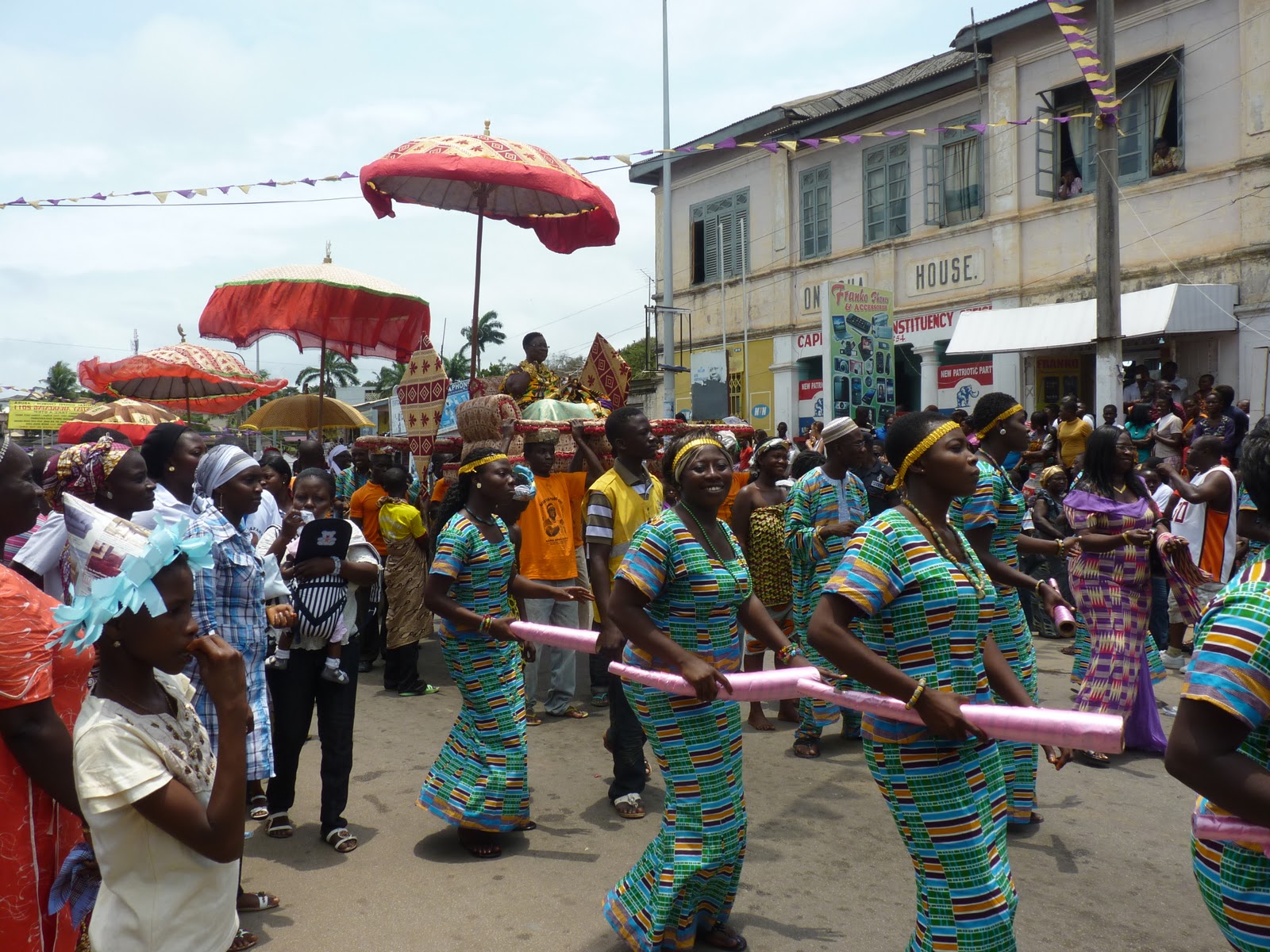
After completing my work in Ghana in September 2011, I finished my 14-month adventure in Cape Coast with the annual "Oguaa Fetu Afahye," or Cape Coast Festival.


Before I left Ghana I learned the organization I worked for was planning to open a site in Cape Town, South Africa. I offered to help set up the site, knowing that I would be visiting the country anyway. So, in September and October I spent a weekend in Johannesburg, a week in Durban, a week around Mbabane, Swaziland (and was stranded there because of the public transportation drivers' riots), and four weeks in Cape Town.

In Cape Town I was contracted by my former employer to meet with local businesses to lay the foundation for the new nongovernmental organization office. I met with over one dozen community partners and set up the projects, accommodation and excursions. The site officially opens in January 2012. It was such a cool experience to network and search for potential business partners in Cape Town and hear about what these innovative enterprises do.

I fell in love with Cape Town, Durban and South Africa's complicated social and political history. Swaziland was also a fascinating country with interesting political history, being the last absolute monarchy in the southern hemisphere. I would love to return some day and spend more time there.

Update:  I actually did end up returning to Swaziland two months after this post. I was hired by a responsible tourism company and lived and worked there for about one year. 

Tuesday, May 31, 2011

Conversations Over Street Food: Religion, Virginity and Love

I set the alarm on my phone for 2:30 a.m. I would have to recruit a taxi driver from the roadside to pick me up at 3 a.m. from my guesthouse. Hopefully I wouldn’t oversleep and hopefully he wouldn’t be late – I didn’t want to miss the bus to Tamale and be stuck in Kumasi another day.

It was almost 4 p.m. With strained effort I got up from the guesthouse’s soft mattress. My body and mind ached for a nap but I knew I should find some dinner instead and head to bed soon after that.

I left the guesthouse and wandered down the street. Bantama is a suburb of Kumasi, the second largest city in Ghana. This street and the ones branching off it were laden with men. Staring and talking at me in Twi, then laughing to each other about it. I was used to friendlier strangers and felt more like a zoo animal rather than a celebrity, a status I had grown accustomed to (but was still skeptical about) in the past 10 months. From the way they were acting I could’ve assumed I had suddenly grown a ghastly tumor on my face.

I turned right at an intersection in hope of finding Ghanaians who wouldn’t stare, jeer, laugh and point at the obroni. And to find a taxi driver for tomorrow morning. And to buy juice – I was feeling fruit-deprived.

Shortly after the turn I found myself on Bantama’s main drag. Loud music blared from every fifth shop, trinkets from the outdoor market crept from the building to the sidewalk, leaving a walkway wide enough for only two people to pass each other. I maneuvered around the neatly stacked displays of shoes, jewelry, purses, black wigs, fabrics, football (soccer) gear and clothes. I turned into a corner shop and bought a box of pineapple juice.

Then I stood on the side of the road and waved an empty taxi car to my side. Without a word, I got inside. I greeted him and and told him I needed a driver to “pick me” from my guesthouse at 3 a.m. I asked if he would do it and he agreed.

“Where to?”
“Metro Mass Station.”
“You mean the station this way or this way?” he asked, pointing forward and then behind him.
“This way. Metro Mass Station,” I said, pointing behind us. I felt a surge of gratefulness for Isaac, the taxi driver who drove me from the Metro Mass Station to the guesthouse and showed me how close it was.
“Oh, ok,” he said. “And please, where is the guesthouse?”
“I will show you. Drive forward and pass right here.”

I directed him to the guesthouse which was around the corner from where I had gotten into his car. We negotiated a price for the morning fare. He tried charging me 10 cedis but I knew the distance was more deserving of three. He laughed when I called him out on it and agreed to three cedis. We took each other’s names and numbers and parted ways.

Now back at the front of my guesthouse, I continued down the street again in search of a rice stand. I found one past the intersection that initially I had turned onto. Spacious enough for two to work inside, the stall had countertops on each side and plastic windows to keep the flies out.

I said "good afternoon" to one of the two women working inside the stall, the woman nearest to the front cage screen. She looked up from scooping rice into a plastic bag for another customer's takeaway and smiled. She spoke in Twi to the other woman but maintained eye contact with me. All I understood was “obroni” and then they both laughed.

She scooped red spicy sauce called "gravy" or "stew" into a plastic bag, then scooped the rice on top of the sauce. I asked for 30 pesewas of salad (coleslaw), an egg (available at rice stands in hardboiled form) and stew (spicy and sometimes fishy reddish brown sauce). She added those bits, wrapped the plastic bag in newspaper and put it inside another black plastic bag. I paid and left before remembering to ask for a plate and utensils. I was in a hurry to leave - I felt unwanted and disrespected as a foreigner there, with the woman talking about me, at me but in another language which she knew I didn't understand, to everyone around.

About 20 paces down the street back toward the guesthouse, I approached a teenage girl as she was walking through the side door of a rice stand. We exchanged greetings. I asked if I could use a plate and utensils. She shook her head quickly and said, “No.”

The next business that was open was another rice stand a few meters from the entrance of my guesthouse. I had walked by earlier but no one was around except a woman sprawled on a bench behind the stand sleeping. As I walked by again I saw she was still laying on the bench but was awake and staring at me. I went over to her behind the stall, greeted her and asked if I could use a plate.

“O, yes, come,” she said, sitting up abruptly. “What food is it?” she asked, moving into the stall. Her hand hesitated between a bowl and a plate.

I told her it was rice and she looked a little disappointed. I explained I had come by her rice stand earlier but she was sleeping and I didn’t want to wake her.

“O! It is fine!” she replied. She rinsed a bowl in a tub of water, shook the water droplets off and handed it to me. I removed my food from the outer bag and newspaper, pulled apart the plastic and dumped the food into the bowl.

“Will you eat with a spoon or your hands?” the woman asked.
“Normally I would eat with my hands but I don’t want to today.” I wanted her to know that I do like to learn and practice her culture.

She washed a spoon and handed it to me. She sat on the bench next to me and leaned back against the white wall. We talked about our Ghanaian names, our ages, why I’m in Ghana, where I’m from, who she knows in the states, if I go to church, what religion I practice, which church, etc. Her name is Adjowa, she is 37 years and she has four children ages six to 13. She is married. She met her husband in their church's choir practices. She is a Baptist. Her rice stand has been on this street corner for five years and she is from this town, Bantama.

“So, do you want me to be your pal?” Adjowa asked.
“Yes, of course!”
“I will be your senior sister, and you will be my junior sister.”
“I would like that very much.”
“Do you have a driver for tomorrow when you leave early in the morning?”
“Yes.”
“Do you know him?”
I knew his name, his number and that he’s a driver in Kumasi. “Yes.”
“Is he a good driver?”
“He is.”
“So will you wait for him here?” Adjowa pointed around me to the front entrance of the guesthouse, where I had told her I was staying.
“Yes.”
“Ok,” Adjowa nodded. Her eyes moved left to right over the street. “Where do you live? Does your place of work have a living quarters?”
“No, I live in a different part of town than where my office is.”
“Do you rent space?”
“Yes, the organization I work for rents it for me and my roommate.”
“How many rooms? Do you have three rooms?”
“Yes!”
“Do you have a hallway?”
“No, we have three separate rooms, each with doors. We have a self-contained kitchen, and it is connected to another room that has our shower and toilet,” I responded.
“Are you a virgin?”

WOW...did she seriously just ask that? I stifled a laugh. I nodded slowly and said "yes," remembering from our conversation earlier that she is a very religious woman. The judgmental type, I suspected. A woman who goes to church Sundays, Tuesdays, Wednesdays, Thursdays and Fridays – sometimes twice a day – would not like hearing that I wasn’t a virgin if I am not married. But, wait a minute. How is my sex life related to where I live?!

“Thank God!” Adjowa exclaimed. Please, laughter, stay inside. “Thank God you have kept yourself. Because men will take you and then dump you, you know that?”
“Yes,” I responded solemnly.

I was more a spectator in this conversation than an active participant. I could’ve shared what I really thought, but I didn’t want disharmony – especially not while I was eating.

Yet, out of desire for more amusement, I blurted a Ghanaian phrase that took the middle road between my polite answers catered for strangers and my real thoughts. “But it’s hard-o.”
“Yes, but thank God you have kept yourself.” Adjowa continued, “You said you are not married and do not have a fiancé – do you have someone in mind?”
“For me, there is almost always someone in mind. I never start that serious though.”
“Then is your fiancé white or black?”
“I don’t have a fiancé.”
“You said you have someone you want to marry.”

I wanted to explain that crushing is different than dating, dating for fun is different than dating someone you could marry, and most people who are in a relationship don't know for at least a year or two and sometimes longer if they want to marry that person.

Instead I said, “Oh, I don’t want to marry anyone right now. In the states, usually being attracted to someone just makes you want to get to know the other person. Then, if you become friends, you might want to date more seriously and eventually become fiancés. Those feelings take time to grow.”

I noticed Adjowa had stopped listening and was staring intently at my bare arms beaded in sweat. “Where is your handkerchief?” she asked. I pointed to my bag. “You are too wet! I will get your handkerchief for you.”
I laughed. “Yes, I am always wet in Ghana. Eating hot food makes me even more wet.” In Ghana people say "hot" when they mean "spicy."
Adjowa reached into my bag and placed my purple and orange plaid handkerchief in my lap next to my half-eaten bowl of rice. “Finish your food. Keep the houseflies away and then you can use your handkerchief.”

I smiled to myself as I spooned more bites into my mouth.

“Do you want a white or black husband?” Adjowa asked.
“You can’t choose who you fall in love with.”
Adjowa was clearly fishing for a juicier answer. “Do you want to marry a rich man? Or…would you rather marry a rich man or a God-fearing man?”
I paused. “Neither. I want to marry someone I’m compatible with and who loves me for who I am and who challenges me to be a better person.”

Blank stare and silence.

“But you wouldn’t want to marry a God-fearing man?” she pressed. “You wouldn’t want to marry a man who fears God?”
“No.”
Adjowa’s jaw dropped. I continued, “I don’t like the word ‘fear’ in this context. I would rather have him embrace God, however he understands God.”

I finished my water sachet in silence and glanced sideways at her. Her stare was fixed on the street where half a dozen children were playing tag.

“I must go,” I told her. “I need to sleep.”
We both stood. “You won’t bathe before you sleep?” she asked with concern.
“Oh, you’re right. I should bathe tonight.”

I handed Adjowa my dish, uttered medaase and hiked my bag over my shoulder.

Adjowa grabbed my shoulders and squared them so I was facing her. "You said you are Christian," she said gravely. "Are you a good one?"
"Sometimes. I try."
"You must try harder."
"I will," I assured her.
Adjowa smiled and squeezed my shoulders and stroked my arms. “Safe journey to Tamale tomorrow.”
“Thank you, medaase. We will meet again, Adjowa.”
“Yoo, goodbye, sistah Ekua.”

I walked through the children’s game to my guesthouse, marginally oblivious to their obroni calls, wishing I could've shared that conversation and experience with a friend.
Saturday, April 30, 2011

Expecting Things in Return (And Not)

As our 22-seater van pulled into the Kejetia lorry station, I asked the man sitting next to me if he knew Kumasi well.

“Yes, please, I am from Kumasi,” he said.
“Do you know how much a taxi from Kejetia station to the STC station should be?”

He pondered a few seconds and said it should cost me three cedis. I thanked him. He pulled my bag out from under the seat in front and brought it off the van for me. I thanked him again and scanned the scene for a taxi driver. I didn’t have to try hard – three men engulfed me as soon as I set foot on ground. “Where are you going?” “Need a taxi?” “White woman, need a ride?”

I took my bag from the man and walked away from the crowd to a taxi driver leaning against the hood of his car. I asked him to take me to the STC station.

“OK, let’s go,” he said, moving toward the driver’s seat.
“How much?” I pressed.
He rested his folded arms on the top of the ajar door and gazed across the Kejetia market, the largest open market in West Africa. “You give me 15 cedis.”
“Fifteen?!” I laughed. I turned to walk away and saw the man from the van standing close by, smiling and shaking his head.
The taxi driver followed me. “The traffic is too much at this time of day.”
“The traffic is always too much – this is Kumasi!” I retorted.

I shouldn’t have expected to get a fair price at the lorry station anyway. The lorry stations in Ghana’s bigger cities are known for overcharging drop taxi passengers – foreigners and Ghanaians alike. The Van Man and I walked away from the station along the main Kejetia road. The taxi driver did not follow.

“You will get a taxi for three cedis, don’t worry,” he promised me. I find it amusing that when Ghanaians want to help me they find it necessary to promise that everything will be alright and not to worry. Both men and women do this to foreigners, I’ve noticed. Very peculiar – more on that later though.

We spotted a taxi driver with no passengers inching along the road in traffic. Van Man lowered his head and spoke in Twi to the driver. I was perfectly capable of getting my own taxi but let him help anyway. He looked back up to me, smiled and proudly said, “Three cedis.” I chuckled and thanked him. Before I shut the car door, Van Man asked, “How can I reach you?” I laughed softly to myself – I had felt that one coming. “Next time I’m in Kumasi, maybe I will see you.” I shut the door and waved goodbye.

The lady at the STC bus station was not nearly as helpful. Extracting information from people is one of my duties as an INGO Project Coordinator – I didn’t want to work on my holiday. After a painful question-and-answer session, I finally found out that the STC bus from Kumasi to Tamale this day and the next were already full. I had some wildlife to see – I wasn’t about to lounge around Kumasi for two days before getting a bus, only to take another bus to my final destination. I opted for my next option, the Metro Mass bus, which was positioned inconveniently on the other side of the city. I walked outside to the drop taxi station and asked a driver if he could take me to the Metro Mass station.

This man was a hospitable driver, transportation system informant and tour guide. When we got to the Metro Mass station I asked him to wait for me while I checked to see if I could buy a ticket to Tamale. There wasn’t a line to the Tamale booth, so I walked up to the ticket lady and asked how much a ticket to Tamale would be. “Eight cedis,” she replied. She stood up and began fiddling with the money trays in the money box. I fished eight cedis out of my bag, dropping one bill on the ground. As a frequent dropper of items, I've learned that most Ghanaians will jump to help you clean a mess you've accidentally created but won't assist you in picking up your valuables. I'm wondering if not touching another's possessions stems back to the highly competitive and untrusting nature many Ghanaians associate with their working class.

I slid the money through the open window. The ticket lady clicked the money box shut, then looked at the money and back at me.
“O!” she exclaimed and picked up her purse from the ground and moved to the booth’s exit.
“O, madam. You are leaving?” I asked.
She turned around and said, “Yes.”
“So, no more tickets can be bought for the Tamale bus today?”
“Oh, please, no,” she responded.
My heart sank. “If-only thoughts” tried invading my mind (if only I hadn't gone to the STC station, if only the van from Cape Coast hadn't taken two hours to fill, etc.), but if I gave these thoughts a swift boot out. She turned to leave again. I called after her. “When will you start selling tickets to the next Tamale bus?”
“Four a.m. tomorrow,” she called over her shoulder.

I need to be back here earlier than 4 a.m., I thought. I asked a man nearby when lines form for the 4 a.m. buses. He told me 3:30 a.m. I thanked him and walked over to my waiting taxi, knowing I should be at the station before three.

I got back inside the taxi and sounded out to the driver my last two options. I could either pay another five (ish) cedis to have him drive me to the Tamale tro-tro station, get to Tamale by nightfall, spend the night in Tamale and board the Mole bus the next afternoon, or I could overnight in Kumasi near the Metro Mass station, get a Tamale bus in the morning and try to get to Mole in one day. It was a five-hour ride to Tamale via bus, so that meant it was maybe an eight- or nine-hour drive via tro, not including a potential breakdown along the way. I figured the safer and more relaxing option would be to stay a night in Kumasi.

I asked the driver if he knew any guesthouses nearby. He did but didn’t know the names of them or how much they cost. I took out my Bradt guidebook from my bag and flipped to the Kumasi guesthouse pages. I gave him the book and asked if he knew where each of the cheaper guesthouses were. One by one, he said told me which part of Kumasi the guesthouses were located and whether it was far from the station. They were all far away. “How about you drive me to the closest guesthouse you know?” I asked. “Yes, it isn’t in the guidebook," he said. "I will take you there.”

As he drove from the Metro Mass station, I felt a powerful wave of gratefulness for his willingness to help. And I didn't even know his name! Normally I ask taxi drivers their name as soon as I get in their car, but this time I had forgotten.

"Please, what is your name?" I asked.
"I am Isaac."
"Isaac, very nice to meet you. Thank you for going out of your way to help me."

He beamed and said it was his duty to help obronis like me. Then he explained that we were in Bantama, a suburb of Kumasi, and pointed out recognizable buildings in case I wanted to walk to the station. I wouldn’t, though, because it would be in the middle of the night, but the gesture was sweet anyway. We parked in front of a tall brick building with a white gated patio. The sign on the bricks said it was a café, but the sign on the wall read “Restaurant and Guesthouse.”

The cheapest room was double the price I was looking for (22 cedis per night for a double bed with a fan), but the location was ideal for my early morning, and I had already spent money to get there anyway – asking Isaac to drive me to another guesthouse to compare prices would cost more. I took the room.

After I made the decision to stay, Isaac turned from the front desk lady to me. He looked satisfied that he had properly seen me off.

“So. Your name is?” Isaac asked.
“Michaela.” I took his hand in mine and shook it the Ghanaian way.
"Michaela," he repeated. "It sounds Ghanaian."
"Thank you," I smiled.
“Safe journey tomorrow.” He bowed his head and raised his hand to indicate "goodbye." Spinning on his heels, he walked out the door.
“Medaase.”

It was intriguing that he didn’t try to give me his number and tell me that I should call him to pick me up in the morning. Usually when the conversation between taxi driver and passenger flows well, the drivers try to give you their number and suggest that you call them for a drop taxi ride. Isaac had mentioned that he lives on the other side of town - if he had come to pick me up in the morning, it would’ve cost me more because he would have to drive farther to get to me. It was either very thoughtful of him to not push that on me, or he just didn't want to get up in the middle of the night to drive me around.

I paid for the accommodation and followed the caretaker woman to my room up the stairs and around the corner. The building was open-air - opposite my door was the kitchen. Water running, women singing, pots clanging, but at least it smelled good. I followed the caretaker into my room, set my bags down and walked to the bathroom to turn on the faucet to make sure the water was running. It was. I thanked the woman and sat down on my bed as she left the room. The mattress was a lot softer than mine at home in Cape Coast. I leaned back across the bed and closed my eyes, thinking about how the next day was going to come early and end late. In like a lion and out like a lion.

Saturday, April 16, 2011

Blind Man's Music

Two more passengers was all we needed. As one of the first to board the tro-tro, I had waited two hours for it to fill. We were heading to Kumasi, four hours north of my home in Cape Coast. I was going on a long weekend trip to Mole National Park by myself. (See previous post for details.)

It was more of a van than a tro-tro, as it had almost double the number of seats (22). If you don’t like people touching you or don't do well in small spaces, public transportation in Ghana and probably in the rest of Africa is not for you.

The front had two seats next to the driver and the back looked like this:
Don’t let the divided lines fool you – they are not separated individual seats. They are benches. The bench in front of you is usually about 12 inches away from your chin, and you are thigh to thigh, hip to hip and arm to arm with the person or people next to you. Although tro-tros and vans are not the most comfortable way to get around, the forced physical closeness makes for my most interesting moments in Ghana. This morning was no exception.

An old man in a navy blue jumpsuit too big for his slight body stepped onto our van in the opening space where there was no seat. He faced us. He was blind in a rather painful-looking way. His left pupil was permanently positioned left, revealing a yellowed sclera. Near his right eye's iris was some sort of puncture wound the size of a dime. He lowered his lids halfway (I wondered whether he did this consciously) and began speaking to us in Fante, the main local language spoken in the Central and Western Regions of Ghana. I only know a handful of Fante phrases and words, but knew the gist of what he was saying.

When tro-tros are almost full, salesmen stand by the open door and duck their heads inside to give a minute-long sales pitch on energy drinks, pens with calendars inside them, body soap, religious books, how-to books – you name it. And sometimes on the vans, where there is more room to stand, eloquent gracious representatives of religious bodies (usually Christian churches) will recite a prayer and mention the importance of faith and knowing Jesus and the Lord. Then he wishes the passengers a safe and blessed journey, sings a soulful song and steps out of the van. I’ve witnessed these van prayers three times and each van reacted the same way. Whereas the passengers generally ignore the salesmen on the tros, they clap, exclaim and give money to these people of extraordinary faith.

All I could understand of the old man's prayer was “St. Francis.” He mentioned his name several times. I had no recollection of what St. Francis was known for and wondered why this man chose to speak about him rather than St. Christopher, the patron saint of travelers.

He spoke softly, but his words still reached everyone in the van. His voice sounded as old as his weary eyes looked. Although his eyes didn’t seem to register anything, he moved his head slowly from one side of the van to another as he spoke. He used his hands at times, moving them with control and grace.

The man next to me leaned over my lap to pull his wallet from the back right pocket of his trousers. He took out a one cedi bill and asked the woman sitting in front of him to give it to the man. She took the cedi and placed it inside the man’s idle hand by his waist. His eyes still projected ahead, his fingers fumbled for the money, though not with desperation or greed. He stopped his speech to say, “May God bless you,” and tucked the cedi into his left breast pocket, his finger catching the rim of the pocket, jingling a few coins from the bottom.

He finished the prayer and took out two light wooden cylinder-shaped sticks and began building a rhythm. The sticks were about six inches in length and an inch in width. He hit the right one on the left, rotating the left stick in his hand each time after striking it with the right. The rhythm was simple – one, two, one, two, one, two. It was so genuine. As a devoted admirer of African music, I am convinced Africans are born with musical inclination. There were countless rhythms and combinations of rhythms he could have played with those two sticks, but he chose the simplest, purest beat there is.

In his blind eyes, in his quiet demeanor, I could not detect a trace of sadness or of desperation. He was calm and steady. It was as if his only intention was to bring us faith and hope. When he began to sing, it was too beautiful for me. Too unexpected. Too needed. I couldn’t handle it. My throat swelled and tears brimmed. I laughed quietly at myself and pulled out my wallet. Despite never giving money to those who beg due to its often pointlessness and even negative repercussions, giving money to this blind man seemed like the most natural thing to do. There was no question in my mind about it. From moments like these I've learned there is a difference between sustainable giving and kindness.

In fear of completely losing it, I didn't dare look at the old man again or anyone as I handed a one cedi bill to the man next to me. I asked if he could pass it up. He looked at me, then looked at the van’s open entrance, where girls and women stood by our door with boxes and bowls of food on their heads. “You want a meat pie?” he asked. He probably didn’t think I would give the man a cedi because there was no way I had understood his prayer. A meat pie seemed like a more obvious purchase for a foreigner.

“No, can you give it to that man?” I nodded in his direction.
The guy next to me looked from me to the singing man and then back at me. “That man?”
I nodded, feeling my throat swell again. I kept my gaze unfocused and downward; it would've been impossible to keep the tears in if I had locked eyes with another.
I could hear him smile. “God bless you!” he said, and passed my cedi forward.

I looked the other way out the window, wishing the old man would stop playing his music and stop singing. It was too beautiful.

Friday, April 15, 2011

Traveling Alone in Ghana

I was the third passenger to pay for a seat on a tro-tro from Cape Coast to Kumasi, a four-hour trek north. Nineteen more seats filled after two hours of waiting. Waiting inside the tro, mind you, away from the unforgiving sun. I say “unforgiving” because one would assume the African Sun would give us a few hours in the mornings to collect our wits before penetrating our minds and bodies, but it does not. It’s like your boss calling you before work asking you for that thing you had to do for him. Not cool.

It was pointless to wonder how much quicker that wait would’ve been on a weekend, but I wondered it anyway. Besides updating my work expense log and walking across the station to buy a hardboiled egg with pepper sauce (my favorite street snack) and a loaf of bread to nibble on throughout the weekend, I haven’t a clue how I passed the rest of the time. Probably just people-watched. I’ve become frighteningly skilled at waiting by myself for transportation to show up or to take off. Without a car in Ghana, waiting has become my replacement "zone out time" for when I used to drive from Point A to Point B with no recollection.

I was on the brink of embarking on a four-day solo adventure in the Northern Region of Ghana. Waiting for the Kumasi tro to fill and leave was the shortest wait of the entire weekend – I had 12 more hours of waiting ahead. Traveling alone in Africa is doable if you have patience and a substantial way to unwind. All that waiting by myself made me realize how nice it would’ve been to have had another foreigner to chat with about the less than enjoyable transportation conditions. Being alone forced me to internalize a lot, but it will spew out in my writing in this post and the next couple.

Occasionally, others nearby expressed their disapproval of Ghana’s transportation system by saying in exasperation loud enough for just me to hear, “Oh, Africa!” and shake their heads and sometimes laugh. But that wasn’t enough for me. I wanted to wonder aloud and freely without offending anyone. I wanted to ask someone if the people in charge of selling bus tickets were just being lazy or if they are power-crazed and enjoy watching people breathe down each other’s necks for hours in a line that bulges five people wide all the way to the end.

The only reasons I didn't mind that our line at the Metro Mass station in Kumasi was more resemblant of a concert crowd was because we were standing like that from 3 a.m. to 5:30 a.m. and I was too sleepy to care and it wasn’t hot and humid yet. In one of the lines I stood in at Tamale’s Metro Mass station – imagine being in a mosh pit for an hour at the hottest time of the day – the people at the front were waving money at the closed ticket windows but no one even acknowledged them or had the courtesy to explain why they weren’t accepting payment. Why didn’t they accept our money and give us tickets so we could sit down in the shade and wait for the bus to come? Why did the ticket sellers have to wait until the bus arrived before opening the ticket windows? If that’s “just the way it is,” why? Has anyone in a position of authority in the Metro Mass ticket sales department ever questioned the system? I can’t help but wonder if this principle circles back to Ghana’s education system, in which students are forbidden to ask questions to their teachers and professors out of the cultural expectation that they must respect their elders. Can you imagine living in a country in which you couldn’t challenge the way things are? I cannot. I am grateful, but also sad for this.

Traveling alone in Ghana made me realize I only feel comfortable questioning the way things are in Ghana with other foreigners, and I could not do that last weekend. Although many Ghanaians who engaged me in small talk voiced frustrations about the lateness aspect, I couldn’t share my previous rant with just any Ghanaian. Who knows, it could've been considered offensive. I swallowed many questions and exclamations, as I realized they would only add to the stations’ sporadic negative vibes or reinstigate them. There is nothing I can do to change the situation; I am powerless. So I remained silent. I got a taste of what it's like to not be able to challenge the system. Haven't been given much of that taste in my life. Maybe as one could predict, the most memorable occasions were when I was volunteering and working abroad in "developing nations" - Peru and Ghana.

Ranting about these issues to another foreigner wouldn't have solved anything either, so what is the point of ranting or discussing anything at all if there are no real intentions of doing anything to solve the problems? Is ranting like gossiping...people do it for something to talk about? And foreigners detecting another country's "problems" - is that acceptable? Perhaps. Depends on their sources.

My original plans were to travel alone via bus straight to Bolgatanga (the northernmost city in Ghana) which would take all day. After Couchsurfing in Bolga for a couple nights, I was going to take a bus south to Tamale and another from Tamale to Mole. I wanted the alone time to clear my mind before my work's busy season - May to August, when our NGO swells with volunteers and our staff barely has time to eat and sleep. Then some friends in Cape Coast decided they wanted to go to Mole National Park as well, and they have a van. (You could imagine my excitement.) However, the night before we were supposed to leave, one of the drivers had a family emergency and the plans crumbled. The following morning I tried getting a spot on the next Bolga or Tamale bus but by then both were full, as they only leave Cape Coast once a week and tickets are bought days in advance. I ended up going from Cape Coast to Kumasi, overnighted in Kumasi, Kumasi to Tamale, Tamale to Mole, and the same route back home except all in one day. Yeah, I know. You'll read about it later.

Although I daydreamed about my friends' van throughout the trip, and it would’ve been even more fun to have gone with them, I am grateful I had the alone time. I got to exercise my good humor and growing patience, that’s for sure. I also was able to notice more than when I travel with others, which made for an entire notebook of intriguing writing material.

In due time, readers, in due time.