This is the first summer I can remember that has left me more stressed, more anxious and more exhausted than before it started. Our site has led and accommodated between 20 and 50 volunteers each month from May through August, including four study abroad group programs. With the Project Coordinator Intern's angelic assistance, I have managed all individual volunteer and intern projects and group projects – the miscommunications, the questions, the complaints and the positive feedback from the local project partners, volunteers, interns and faculty leaders. I also approved funding applications and distributed the funds for all these projects (5 projects in May, 12 in June, 17 in July; 9 in August). It was a lot of administrative work and a lot more of putting out fires.
Of the 10 country sites our international nongovernmental organization operates within, the Ghana site was expected to have the most action this summer. After a few months of the Ghana Site Director nagging the President about getting more help on-site, our request was granted in May. Our site grew from four full-time staff members (two local, two foreign) to also include a local temporary Project Coordinator Intern (May-September), a foreign Program Advisor from our marketing department (May-July) and a foreign Volunteer Coordinator (one-year contract). At the end of June, two managers from different departments in our U.S. headquarters office visited for two weeks. It was the first occasion anyone in a managerial position came to our site since it opened in July 2009, a long absence even if the staff hadn’t been stifling complaints about the way things were being managed on-site.
Since mid-May at least once per week there have been personal and professional conflicts among the staff that have resulted in shouting matches, tears and even premeditated public shaming in front of community partners. Somehow I always found myself in the middle, mediating. I’ve been tempted to add to my job description in my resume, "mitigated temper tantrums, nervous breakdowns and verbal attacks between parties."
My blog has been quiet this summer. I assure readers it is not out of laziness. It is because I am tired.
I am emotionally depleted from the 15-hour work days and being on-call 24 hours a day, 7 days a week, approving a volunteer’s ideas for her project money donation at 8 p.m. on a Friday night, being called by a host mother at 10:15 p.m. asking if her “daughter” was at our volunteer house because she hadn’t come home yet and then being woken up at 6:50 a.m. the next morning to a volunteer’s call about a question regarding her host family. It is the nature of the job, yes, but that on top of being the site's unofficial peace-keeper? For project partners, volunteers and staff too? My exhaustion stems from always needing to be available, practical, approachable for others (customers and colleagues) even outside of the regular 8 to 5 work hours. It is one of my personal and professional strengths, but these days and in this particular environment it is wearing me down.
I am also tired because I have so many things to say – about how disheartening it is that young people all over the world come to "the country Africa" to Make A Difference and then get frustrated when they learn that they can’t make a difference in two weeks or even two months because their definition of "help" is different than Ghanaians' definition. (Not all, but most volunteers have this viewpoint - especially the summer batches.) I have more to say about how I don’t like how difficult it is for me to find joy in being a foreigner, always standing out. About how even though I feel safe in Ghana, two lost souls with a gun, a machete and a craving for power shook my core in early June. I hate that I jump and look around when I hear people running now.
A more deep-seeded reason for my silence is because I love Ghana, her people and her culture, and I'm immensely grateful for the experiences I’ve been given. My silence is because I don’t feel like my attitude reflects these feelings right now. I've hardened, I've become jaded and cynical (realistically optimistic?). I don't like it. I hope it doesn't last.
My work contract was from July 2010 to July 2011. In April, before summer bombarded, I made the decision to stay onboard through August 2011 to help with the busy season. After my initial shock of being home in a land of infinite excess and waste and unnatural lights and vanity and refined sugar aromas and mammoth-sized cars and Walmart and who knows what else will toss me off my rocker, I hope I will find peace in the aftermath of this summer.
Showing posts with label discrimination. Show all posts
Showing posts with label discrimination. Show all posts
Sunday, August 14, 2011

Tuesday, May 31, 2011
Conversations Over Street Food: Religion, Virginity and Love
I set the alarm on my phone for 2:30 a.m. I would have to recruit a taxi driver from the roadside to pick me up at 3 a.m. from my guesthouse. Hopefully I wouldn’t oversleep and hopefully he wouldn’t be late – I didn’t want to miss the bus to Tamale and be stuck in Kumasi another day.
It was almost 4 p.m. With strained effort I got up from the guesthouse’s soft mattress. My body and mind ached for a nap but I knew I should find some dinner instead and head to bed soon after that.
I left the guesthouse and wandered down the street. Bantama is a suburb of Kumasi, the second largest city in Ghana. This street and the ones branching off it were laden with men. Staring and talking at me in Twi, then laughing to each other about it. I was used to friendlier strangers and felt more like a zoo animal rather than a celebrity, a status I had grown accustomed to (but was still skeptical about) in the past 10 months. From the way they were acting I could’ve assumed I had suddenly grown a ghastly tumor on my face.
I turned right at an intersection in hope of finding Ghanaians who wouldn’t stare, jeer, laugh and point at the obroni. And to find a taxi driver for tomorrow morning. And to buy juice – I was feeling fruit-deprived.
Shortly after the turn I found myself on Bantama’s main drag. Loud music blared from every fifth shop, trinkets from the outdoor market crept from the building to the sidewalk, leaving a walkway wide enough for only two people to pass each other. I maneuvered around the neatly stacked displays of shoes, jewelry, purses, black wigs, fabrics, football (soccer) gear and clothes. I turned into a corner shop and bought a box of pineapple juice.
Then I stood on the side of the road and waved an empty taxi car to my side. Without a word, I got inside. I greeted him and and told him I needed a driver to “pick me” from my guesthouse at 3 a.m. I asked if he would do it and he agreed.
“Where to?”
“Metro Mass Station.”
“You mean the station this way or this way?” he asked, pointing forward and then behind him.
“This way. Metro Mass Station,” I said, pointing behind us. I felt a surge of gratefulness for Isaac, the taxi driver who drove me from the Metro Mass Station to the guesthouse and showed me how close it was.
“Oh, ok,” he said. “And please, where is the guesthouse?”
“I will show you. Drive forward and pass right here.”
I directed him to the guesthouse which was around the corner from where I had gotten into his car. We negotiated a price for the morning fare. He tried charging me 10 cedis but I knew the distance was more deserving of three. He laughed when I called him out on it and agreed to three cedis. We took each other’s names and numbers and parted ways.
Now back at the front of my guesthouse, I continued down the street again in search of a rice stand. I found one past the intersection that initially I had turned onto. Spacious enough for two to work inside, the stall had countertops on each side and plastic windows to keep the flies out.
I said "good afternoon" to one of the two women working inside the stall, the woman nearest to the front cage screen. She looked up from scooping rice into a plastic bag for another customer's takeaway and smiled. She spoke in Twi to the other woman but maintained eye contact with me. All I understood was “obroni” and then they both laughed.
She scooped red spicy sauce called "gravy" or "stew" into a plastic bag, then scooped the rice on top of the sauce. I asked for 30 pesewas of salad (coleslaw), an egg (available at rice stands in hardboiled form) and stew (spicy and sometimes fishy reddish brown sauce). She added those bits, wrapped the plastic bag in newspaper and put it inside another black plastic bag. I paid and left before remembering to ask for a plate and utensils. I was in a hurry to leave - I felt unwanted and disrespected as a foreigner there, with the woman talking about me, at me but in another language which she knew I didn't understand, to everyone around.
About 20 paces down the street back toward the guesthouse, I approached a teenage girl as she was walking through the side door of a rice stand. We exchanged greetings. I asked if I could use a plate and utensils. She shook her head quickly and said, “No.”
The next business that was open was another rice stand a few meters from the entrance of my guesthouse. I had walked by earlier but no one was around except a woman sprawled on a bench behind the stand sleeping. As I walked by again I saw she was still laying on the bench but was awake and staring at me. I went over to her behind the stall, greeted her and asked if I could use a plate.
“O, yes, come,” she said, sitting up abruptly. “What food is it?” she asked, moving into the stall. Her hand hesitated between a bowl and a plate.
I told her it was rice and she looked a little disappointed. I explained I had come by her rice stand earlier but she was sleeping and I didn’t want to wake her.
“O! It is fine!” she replied. She rinsed a bowl in a tub of water, shook the water droplets off and handed it to me. I removed my food from the outer bag and newspaper, pulled apart the plastic and dumped the food into the bowl.
“Will you eat with a spoon or your hands?” the woman asked.
“Normally I would eat with my hands but I don’t want to today.” I wanted her to know that I do like to learn and practice her culture.
She washed a spoon and handed it to me. She sat on the bench next to me and leaned back against the white wall. We talked about our Ghanaian names, our ages, why I’m in Ghana, where I’m from, who she knows in the states, if I go to church, what religion I practice, which church, etc. Her name is Adjowa, she is 37 years and she has four children ages six to 13. She is married. She met her husband in their church's choir practices. She is a Baptist. Her rice stand has been on this street corner for five years and she is from this town, Bantama.
“So, do you want me to be your pal?” Adjowa asked.
“Yes, of course!”
“I will be your senior sister, and you will be my junior sister.”
“I would like that very much.”
“Do you have a driver for tomorrow when you leave early in the morning?”
“Yes.”
“Do you know him?”
I knew his name, his number and that he’s a driver in Kumasi. “Yes.”
“Is he a good driver?”
“He is.”
“So will you wait for him here?” Adjowa pointed around me to the front entrance of the guesthouse, where I had told her I was staying.
“Yes.”
“Ok,” Adjowa nodded. Her eyes moved left to right over the street. “Where do you live? Does your place of work have a living quarters?”
“No, I live in a different part of town than where my office is.”
“Do you rent space?”
“Yes, the organization I work for rents it for me and my roommate.”
“How many rooms? Do you have three rooms?”
“Yes!”
“Do you have a hallway?”
“No, we have three separate rooms, each with doors. We have a self-contained kitchen, and it is connected to another room that has our shower and toilet,” I responded.
“Are you a virgin?”
WOW...did she seriously just ask that? I stifled a laugh. I nodded slowly and said "yes," remembering from our conversation earlier that she is a very religious woman. The judgmental type, I suspected. A woman who goes to church Sundays, Tuesdays, Wednesdays, Thursdays and Fridays – sometimes twice a day – would not like hearing that I wasn’t a virgin if I am not married. But, wait a minute. How is my sex life related to where I live?!
“Thank God!” Adjowa exclaimed. Please, laughter, stay inside. “Thank God you have kept yourself. Because men will take you and then dump you, you know that?”
“Yes,” I responded solemnly.
I was more a spectator in this conversation than an active participant. I could’ve shared what I really thought, but I didn’t want disharmony – especially not while I was eating.
Yet, out of desire for more amusement, I blurted a Ghanaian phrase that took the middle road between my polite answers catered for strangers and my real thoughts. “But it’s hard-o.”
“Yes, but thank God you have kept yourself.” Adjowa continued, “You said you are not married and do not have a fiancé – do you have someone in mind?”
“For me, there is almost always someone in mind. I never start that serious though.”
“Then is your fiancé white or black?”
“I don’t have a fiancé.”
“You said you have someone you want to marry.”
I wanted to explain that crushing is different than dating, dating for fun is different than dating someone you could marry, and most people who are in a relationship don't know for at least a year or two and sometimes longer if they want to marry that person.
Instead I said, “Oh, I don’t want to marry anyone right now. In the states, usually being attracted to someone just makes you want to get to know the other person. Then, if you become friends, you might want to date more seriously and eventually become fiancés. Those feelings take time to grow.”
I noticed Adjowa had stopped listening and was staring intently at my bare arms beaded in sweat. “Where is your handkerchief?” she asked. I pointed to my bag. “You are too wet! I will get your handkerchief for you.”
I laughed. “Yes, I am always wet in Ghana. Eating hot food makes me even more wet.” In Ghana people say "hot" when they mean "spicy."
Adjowa reached into my bag and placed my purple and orange plaid handkerchief in my lap next to my half-eaten bowl of rice. “Finish your food. Keep the houseflies away and then you can use your handkerchief.”
I smiled to myself as I spooned more bites into my mouth.
“Do you want a white or black husband?” Adjowa asked.
“You can’t choose who you fall in love with.”
Adjowa was clearly fishing for a juicier answer. “Do you want to marry a rich man? Or…would you rather marry a rich man or a God-fearing man?”
I paused. “Neither. I want to marry someone I’m compatible with and who loves me for who I am and who challenges me to be a better person.”
Blank stare and silence.
“But you wouldn’t want to marry a God-fearing man?” she pressed. “You wouldn’t want to marry a man who fears God?”
“No.”
Adjowa’s jaw dropped. I continued, “I don’t like the word ‘fear’ in this context. I would rather have him embrace God, however he understands God.”
I finished my water sachet in silence and glanced sideways at her. Her stare was fixed on the street where half a dozen children were playing tag.
“I must go,” I told her. “I need to sleep.”
We both stood. “You won’t bathe before you sleep?” she asked with concern.
“Oh, you’re right. I should bathe tonight.”
I handed Adjowa my dish, uttered medaase and hiked my bag over my shoulder.
Adjowa grabbed my shoulders and squared them so I was facing her. "You said you are Christian," she said gravely. "Are you a good one?"
"Sometimes. I try."
"You must try harder."
"I will," I assured her.
Adjowa smiled and squeezed my shoulders and stroked my arms. “Safe journey to Tamale tomorrow.”
“Thank you, medaase. We will meet again, Adjowa.”
“Yoo, goodbye, sistah Ekua.”
I walked through the children’s game to my guesthouse, marginally oblivious to their obroni calls, wishing I could've shared that conversation and experience with a friend.
It was almost 4 p.m. With strained effort I got up from the guesthouse’s soft mattress. My body and mind ached for a nap but I knew I should find some dinner instead and head to bed soon after that.
I left the guesthouse and wandered down the street. Bantama is a suburb of Kumasi, the second largest city in Ghana. This street and the ones branching off it were laden with men. Staring and talking at me in Twi, then laughing to each other about it. I was used to friendlier strangers and felt more like a zoo animal rather than a celebrity, a status I had grown accustomed to (but was still skeptical about) in the past 10 months. From the way they were acting I could’ve assumed I had suddenly grown a ghastly tumor on my face.
I turned right at an intersection in hope of finding Ghanaians who wouldn’t stare, jeer, laugh and point at the obroni. And to find a taxi driver for tomorrow morning. And to buy juice – I was feeling fruit-deprived.
Shortly after the turn I found myself on Bantama’s main drag. Loud music blared from every fifth shop, trinkets from the outdoor market crept from the building to the sidewalk, leaving a walkway wide enough for only two people to pass each other. I maneuvered around the neatly stacked displays of shoes, jewelry, purses, black wigs, fabrics, football (soccer) gear and clothes. I turned into a corner shop and bought a box of pineapple juice.
Then I stood on the side of the road and waved an empty taxi car to my side. Without a word, I got inside. I greeted him and and told him I needed a driver to “pick me” from my guesthouse at 3 a.m. I asked if he would do it and he agreed.
“Where to?”
“Metro Mass Station.”
“You mean the station this way or this way?” he asked, pointing forward and then behind him.
“This way. Metro Mass Station,” I said, pointing behind us. I felt a surge of gratefulness for Isaac, the taxi driver who drove me from the Metro Mass Station to the guesthouse and showed me how close it was.
“Oh, ok,” he said. “And please, where is the guesthouse?”
“I will show you. Drive forward and pass right here.”
I directed him to the guesthouse which was around the corner from where I had gotten into his car. We negotiated a price for the morning fare. He tried charging me 10 cedis but I knew the distance was more deserving of three. He laughed when I called him out on it and agreed to three cedis. We took each other’s names and numbers and parted ways.
Now back at the front of my guesthouse, I continued down the street again in search of a rice stand. I found one past the intersection that initially I had turned onto. Spacious enough for two to work inside, the stall had countertops on each side and plastic windows to keep the flies out.
I said "good afternoon" to one of the two women working inside the stall, the woman nearest to the front cage screen. She looked up from scooping rice into a plastic bag for another customer's takeaway and smiled. She spoke in Twi to the other woman but maintained eye contact with me. All I understood was “obroni” and then they both laughed.
She scooped red spicy sauce called "gravy" or "stew" into a plastic bag, then scooped the rice on top of the sauce. I asked for 30 pesewas of salad (coleslaw), an egg (available at rice stands in hardboiled form) and stew (spicy and sometimes fishy reddish brown sauce). She added those bits, wrapped the plastic bag in newspaper and put it inside another black plastic bag. I paid and left before remembering to ask for a plate and utensils. I was in a hurry to leave - I felt unwanted and disrespected as a foreigner there, with the woman talking about me, at me but in another language which she knew I didn't understand, to everyone around.
About 20 paces down the street back toward the guesthouse, I approached a teenage girl as she was walking through the side door of a rice stand. We exchanged greetings. I asked if I could use a plate and utensils. She shook her head quickly and said, “No.”
The next business that was open was another rice stand a few meters from the entrance of my guesthouse. I had walked by earlier but no one was around except a woman sprawled on a bench behind the stand sleeping. As I walked by again I saw she was still laying on the bench but was awake and staring at me. I went over to her behind the stall, greeted her and asked if I could use a plate.
“O, yes, come,” she said, sitting up abruptly. “What food is it?” she asked, moving into the stall. Her hand hesitated between a bowl and a plate.
I told her it was rice and she looked a little disappointed. I explained I had come by her rice stand earlier but she was sleeping and I didn’t want to wake her.
“O! It is fine!” she replied. She rinsed a bowl in a tub of water, shook the water droplets off and handed it to me. I removed my food from the outer bag and newspaper, pulled apart the plastic and dumped the food into the bowl.
“Will you eat with a spoon or your hands?” the woman asked.
“Normally I would eat with my hands but I don’t want to today.” I wanted her to know that I do like to learn and practice her culture.
She washed a spoon and handed it to me. She sat on the bench next to me and leaned back against the white wall. We talked about our Ghanaian names, our ages, why I’m in Ghana, where I’m from, who she knows in the states, if I go to church, what religion I practice, which church, etc. Her name is Adjowa, she is 37 years and she has four children ages six to 13. She is married. She met her husband in their church's choir practices. She is a Baptist. Her rice stand has been on this street corner for five years and she is from this town, Bantama.
“So, do you want me to be your pal?” Adjowa asked.
“Yes, of course!”
“I will be your senior sister, and you will be my junior sister.”
“I would like that very much.”
“Do you have a driver for tomorrow when you leave early in the morning?”
“Yes.”
“Do you know him?”
I knew his name, his number and that he’s a driver in Kumasi. “Yes.”
“Is he a good driver?”
“He is.”
“So will you wait for him here?” Adjowa pointed around me to the front entrance of the guesthouse, where I had told her I was staying.
“Yes.”
“Ok,” Adjowa nodded. Her eyes moved left to right over the street. “Where do you live? Does your place of work have a living quarters?”
“No, I live in a different part of town than where my office is.”
“Do you rent space?”
“Yes, the organization I work for rents it for me and my roommate.”
“How many rooms? Do you have three rooms?”
“Yes!”
“Do you have a hallway?”
“No, we have three separate rooms, each with doors. We have a self-contained kitchen, and it is connected to another room that has our shower and toilet,” I responded.
“Are you a virgin?”
WOW...did she seriously just ask that? I stifled a laugh. I nodded slowly and said "yes," remembering from our conversation earlier that she is a very religious woman. The judgmental type, I suspected. A woman who goes to church Sundays, Tuesdays, Wednesdays, Thursdays and Fridays – sometimes twice a day – would not like hearing that I wasn’t a virgin if I am not married. But, wait a minute. How is my sex life related to where I live?!
“Thank God!” Adjowa exclaimed. Please, laughter, stay inside. “Thank God you have kept yourself. Because men will take you and then dump you, you know that?”
“Yes,” I responded solemnly.
I was more a spectator in this conversation than an active participant. I could’ve shared what I really thought, but I didn’t want disharmony – especially not while I was eating.
Yet, out of desire for more amusement, I blurted a Ghanaian phrase that took the middle road between my polite answers catered for strangers and my real thoughts. “But it’s hard-o.”
“Yes, but thank God you have kept yourself.” Adjowa continued, “You said you are not married and do not have a fiancé – do you have someone in mind?”
“For me, there is almost always someone in mind. I never start that serious though.”
“Then is your fiancé white or black?”
“I don’t have a fiancé.”
“You said you have someone you want to marry.”
I wanted to explain that crushing is different than dating, dating for fun is different than dating someone you could marry, and most people who are in a relationship don't know for at least a year or two and sometimes longer if they want to marry that person.
Instead I said, “Oh, I don’t want to marry anyone right now. In the states, usually being attracted to someone just makes you want to get to know the other person. Then, if you become friends, you might want to date more seriously and eventually become fiancés. Those feelings take time to grow.”
I noticed Adjowa had stopped listening and was staring intently at my bare arms beaded in sweat. “Where is your handkerchief?” she asked. I pointed to my bag. “You are too wet! I will get your handkerchief for you.”
I laughed. “Yes, I am always wet in Ghana. Eating hot food makes me even more wet.” In Ghana people say "hot" when they mean "spicy."
Adjowa reached into my bag and placed my purple and orange plaid handkerchief in my lap next to my half-eaten bowl of rice. “Finish your food. Keep the houseflies away and then you can use your handkerchief.”
I smiled to myself as I spooned more bites into my mouth.
“Do you want a white or black husband?” Adjowa asked.
“You can’t choose who you fall in love with.”
Adjowa was clearly fishing for a juicier answer. “Do you want to marry a rich man? Or…would you rather marry a rich man or a God-fearing man?”
I paused. “Neither. I want to marry someone I’m compatible with and who loves me for who I am and who challenges me to be a better person.”
Blank stare and silence.
“But you wouldn’t want to marry a God-fearing man?” she pressed. “You wouldn’t want to marry a man who fears God?”
“No.”
Adjowa’s jaw dropped. I continued, “I don’t like the word ‘fear’ in this context. I would rather have him embrace God, however he understands God.”
I finished my water sachet in silence and glanced sideways at her. Her stare was fixed on the street where half a dozen children were playing tag.
“I must go,” I told her. “I need to sleep.”
We both stood. “You won’t bathe before you sleep?” she asked with concern.
“Oh, you’re right. I should bathe tonight.”
I handed Adjowa my dish, uttered medaase and hiked my bag over my shoulder.
Adjowa grabbed my shoulders and squared them so I was facing her. "You said you are Christian," she said gravely. "Are you a good one?"
"Sometimes. I try."
"You must try harder."
"I will," I assured her.
Adjowa smiled and squeezed my shoulders and stroked my arms. “Safe journey to Tamale tomorrow.”
“Thank you, medaase. We will meet again, Adjowa.”
“Yoo, goodbye, sistah Ekua.”
I walked through the children’s game to my guesthouse, marginally oblivious to their obroni calls, wishing I could've shared that conversation and experience with a friend.
Tuesday, March 15, 2011
Public Urination vs. Paying to Pee: I wish I had the choice
I strongly believe people should not pay to use a toilet. It’s like paying to breathe. Can you imagine? “That’s my air you’re breathing. I look after it and keep it clean, so pay up!” Especially considering the public “toilets” in Ghana are in fact not toilets at all, but a wall with a door (and occasionally a ceiling), a standing block and a hole in the ground. Perhaps my biggest sticking point about this pay-to-pee policy is that it does not suit a society that allows public urination. Public urination for Ghanaians only, that is.
Why can’t I relieve myself in semi-public? Yet, the inconvenience of this double standard doesn’t bother me enough to want to try to pull it off – I am certain it wouldn’t go over well if I were caught by a Ghanaian who disapproved of public urination. Especially considering many Ghanaians think obronis are more intelligent than they are simply because we aren't from Africa. They probably think we're above peeing in public. Well, this girl isn't.
Instead, I have to "be a lady" and hold it until I find a stall and when I’m finished pay the man or woman sitting on a stool outside the stalls who seven times out of 10 – I wish I was exaggerating – try to cheat me by saying it’s 20 pesewas instead of the usual 10.
Double standards piss me off. (High fives for pun fun!)
A special thanks to growing up with guy friends who were practically extras in the TV show Jack Ass, enjoying the reputation of the daredevil in my group of girl friends in middle school and high school, and my rowdy freshmen and sophomore years of college, I am more than comfortable peeing in public. Though, I prefer to call it “wilderness urination.” To any cops reading this, only once have I urinated on an unnatural object, and I don’t regret it at all. (Taco Bell, once upon a time when your drive thru window was open until three a.m., customers like me took that seriously. Quarter to three is still before three. And nevermind that I had tried to order from your drive thru window by foot.)
Now that I've made it clear I’m neither shy nor reluctant to urinate in public, it should also be known that that doesn’t mean I have the skill and confidence to do it in plain sight like many Ghanaians. Some men even carry on a conversation while peeing. Some wave with one hand while guiding with the other. I’m not quite at that level yet.
Now that I've made it clear I’m neither shy nor reluctant to urinate in public, it should also be known that that doesn’t mean I have the skill and confidence to do it in plain sight like many Ghanaians. Some men even carry on a conversation while peeing. Some wave with one hand while guiding with the other. I’m not quite at that level yet.
The only thing holding me back from semi-public urination - ducking into an alleyway or behind a quiet building - is that I am a foreigner, a white sheep among a flock of black. I realize people from home may take offense to this backwards expression, but I've been away from the overly politically correct society for a while now and regularly converse with Ghanaians who use the terms "blacks" and "whites" instead of "locals" or "Ghanaians" and "foreigners." I'm over color sensitivity, at least until I go back to the states. Back to my point, the kids in Ghana (Cape Coast especially) practically have a heart attack every time they see an obroni – I don’t want to know what would happen to them if they saw a white female squatting with her underwear down. White male foreigners are luckier - peeing while standing up is far less conspicuous.
Why can’t I relieve myself in semi-public? Yet, the inconvenience of this double standard doesn’t bother me enough to want to try to pull it off – I am certain it wouldn’t go over well if I were caught by a Ghanaian who disapproved of public urination. Especially considering many Ghanaians think obronis are more intelligent than they are simply because we aren't from Africa. They probably think we're above peeing in public. Well, this girl isn't.
Instead, I have to "be a lady" and hold it until I find a stall and when I’m finished pay the man or woman sitting on a stool outside the stalls who seven times out of 10 – I wish I was exaggerating – try to cheat me by saying it’s 20 pesewas instead of the usual 10.
Double standards piss me off. (High fives for pun fun!)
Monday, December 13, 2010
Friends in Low Places
I am in Ghana on a tourist visa. I was granted 60 days upon arrival, renewed my visa in September for three months and was due for a second renewal on December 8th. If I had a work visa, which we are in the process of obtaining, I wouldn’t have to renew my visa at all. But that is neither here nor there.
So here’s the pickle: About every other week day, an immigration officer takes a bag of the visas-to-be-renewed to Ghana’s capital, Accra, which is a bulk of the reason it takes approximately two weeks to process the visa renewal for all mainstream requests. I am leaving Cape Coast on Friday, December 17 to visit Togo with a friend for a week. I need my visa/passport to get into Togo; therefore, I needed to have my visa returned to Cape Coast by the 17th. To get my visa back by then, I needed to get it renewed no later than December 3rd.
Toward the end of November I told my boss Kirsty about my December 3rd deadline. She said the Cape Coast immigration office has a rule stating that foreigners are prohibited from renewing their visa more than one time at the immigration office in Cape Coast if they have not left Ghana since their arrival. I have not left Ghana since I arrived in July, and I had already renewed my visa once in Cape Coast.
Traveling to a neighboring country to renew my visa was out of the question – I just needed a quick fix to tide me over until I go to Togo. I could’ve taken a three-hour tro-tro or Ford van ride to Accra, but I’ve read that the Accra office can take a couple days to sort out a visa renewal, and unfortunately I can’t afford to take time off from work right now. I considered what would happen if I would let my visa expire from December 8th until the 18th when I’d arrive to Togo, where I could get a new visa at the border. On second thought I decided I’d rather be on the good side of Togo’s border patrol – no need to ruffle any feathers by entering a country on an expired visa.
After telling Kirsty I could try going to Accra, she mentioned that our Ghanaian friend Eric has a friend in the immigration office in Cape Coast who would be able to take care of my situation in a matter of days. Days? What happened to the two-week process? On numerous occasions I’ve benefited from “knowing people” but never with this small amount of my own merit.
The weekend before my visa was due for a renewal, I started to doubt this alleged immigration connection. What if the guy can’t pull the strings Eric said he’d pull? If my visa isn’t returned by December 17th, I won’t be able to go to Togo – a vacation I’ve been looking forward to for months, down time I need desperately before the influx of volunteers coming January and an adventure I’m excited to share with my good friend who’s flying all the way from the U.S.
Okay, okay… surrender your throne, Drama Queen. Or is that more diva-like? Whatever, I would still be able to go to Togo, just not as long as I’d hoped. But still – the fact that I had anticipated this time crunch and could have taken the visa to Accra myself instead of relying on some random source… but why worry? All I can do now, I thought, is tell myself in my most Ghanaian voice, “It twill be fiiine.”
Two days before my visa expired, Kirsty got the phone number of the immigration guy from Eric. She had met the man, Jude (name has been changed for security purposes), a few weeks earlier when she was due for a renewal herself, so she called him to find out when I would be able to catch him at the immigration office. She returned to my office and relayed to me that Jude was in Accra Monday and Tuesday, so I should go to the Cape Coast immigration office on Wednesday. I’d been instructed not to leave visa renewals for the last minute, or “until the eleventh hour,” as a Ghanaian friend put it once. I hoped this guy knew my visa would expire that day but figured Kirsty or Eric had told him.
The day before my visa expired, my friend Joeva said she read that nine foreigners were deported recently for having expired visas. It was especially wonderful hearing this after I had already convinced myself the worst case scenario would be paying a 40-cedi fine for allowing the visa to expire, or not getting my visa returned before I wanted to leave for Togo. Thanks, Jo. Such a fountain of information, that girl.
Wednesday morning I went through the visa renewal checklist of required materials: a printout of my return flight itinerary, a letter written by a superior from my NGO requesting my visa renewal, a copy of my NGO’s certificate, 40 cedis for a one-month extension (I will request a 60-day visa upon my return to Ghana from Togo), and 5 cedis to get four passport-size pictures taken at the photo booth on my way to the immigration office. I walked from our office to the main junction and took a shared taxi to town. I alighted at Kingsway in front of the Melcom superstore and walked toward the Cape Coast slave castle to the photo booth just outside the immigration office.
I thought about joking with the photographer about why he didn’t ask to take my remaining two photos of the set of four (only two photos are required for visa purposes) like he did the last time he took my picture for my visa renewal in September, but decided against it. I didn’t think he’d remember me from the first time and reasoned he, like many Ghanaians, may not understand that sort of humor (“What, did I get uglier over three months?”).
I called Jude as I walked through the front entrance and waited at the door for him to meet me. The building contains more offices than just the immigration office, but to me the entire building is called the immigration office. It’s my favorite building in Ghana that I’ve been inside. It’s open-air; birds fly free and not silently and the blue sky is ceiling to maybe 8 to 10 floors, which are situated on the outside of the circular building and the central part of the ground floor is a circle of well-groomed grass.
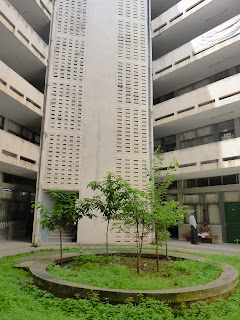
 A Ghanaian man in a jungle green immigration uniform sauntered toward me from the bottom of the staircase across the hall, one hand holding his cell phone to his ear and the other grasping a newspaper. His eyes were glued to me for about 10 paces - I was the only white person in the front entry way, so I figured he knew who I was. Respectively, I took him for Jude.
Now standing in front of me, he was still on the phone. I shook his hand and stood in front of him awkwardly as he finished his conversation.
“Hello, I am Michaela. Eric’s friend.”
“Yeah,” he said, smiling from my face to my hand, which was still in his. “Is that your car?” He motioned to the car parked on the street in front of the entrance. A Ghanaian man was in the driver seat.
“Um, no, it’s not.”
“Oh,” he replied, sounding disappointed. He let go of my hand. “Is Eric coming?” he asked, looking outside again.
“No, he isn’t,” I told him. “He is in Accra today. With Kirsty, my sister you talked to on the phone on Monday.”
“Ohh, I see, I see, I see. How did you get here?”
“By taxi. I took a shared taxi from my office to town.” I may be an obroni and I may be a female, if that’s what he’s getting at, but that doesn’t make me helpless!
We walked across the hall to the staircase. “You have all the documents?” he asked.
“Yes,” I nodded.
“And Eric has told you everything?”
I paused. Told me everything? That sounds so omnious, I thought. What else is there to know?
“Yes, he has.”
Jude smiled. “Good. It will be fine then.”
What will be fine?
As he led me into his office I wondered if he could tell I hadn't a clue what he was talking about. Three wooden desks were arranged in the shape of a digital U and three wooden chairs were in the middle of the open space. Jude pulled one of the chairs over to the side of his desk, which was parallel with the window. “Sit here,” he told me. He tossed the newspaper on his desk and squeezed between the middle desk and his. I wondered how many months or maybe even years it would take him and the others he shared the office with to realize they wouldn’t have to squeeze between the desks if they would simply move the desks farther apart.
I took out of my bag the folder containing all the necessary documents and handed them to Jude. He leafed through my passport. “An American, I see. That is my favorite country. So when are you taking me to the U.S.?”
When Ghanaians ask me that question, normally I answer, “When you’ve saved up enough money for your plane ticket!” But I couldn’t say things like that to this man, or anyone who works for Ghana’s immigration offices for that matter. I needed to convince him I will do whatever it takes to stay in Ghana.
“Well, I love Ghana. I want to stay here for long long time. But maybe after that you can come to the U.S.” Because I’m in Ghana on a tourist visa, I couldn’t carry on and express my love for Ghana by telling him I want to stay for two years – that would blow my cover. No one is a tourist for two years.
We really need to light a fire under our employer's bum to get us the documents we need for a work visa.
“July…” he muttered to himself, flipping through the pages of my passport again.
“Yes, July. I’ve been here long time.” Saying that probably didn't help my case, but he would’ve done the math anyway. He examined my passport for another minute, closed it and said, “Wow.”
Something was wrong.
Jude looked at me and shook the passport his hand. “You’ve already renewed your visa in Cape Coast once. You should have taken it to Accra this time.”
“Yes, and Eric said you could help me so I wouldn’t have to take my visa to Accra this time.”
He opened the passport again and flipped through the pages to my visa. “It expires on eighth of December,” he paused. “That is today.”
“Yes,” I said sheepishly. This was one of the rare occasions I was not a procrastinator by choice. “But I am going to Togo on the 18th of this month, so I can get it renewed when I am reentering Ghana – ” He looked up at me and I finished, “ – That is the reason I only want a one-month extension.”
Jude continued to examine the visa page of my passport. “Yes, you can only renew your visa in Cape Coast one time. I will have to talk to my boss about this.”
“Oh, okay. Also, this may not be an issue yet but I will need my visa back before December 17th because I am going to Togo.”
“How long you stay in Togo?”
“About a week.”
“You are going alone?”
“No, I’m going with a friend. He’s coming to visit me. And Ghana.”
“Ah, that is nice,” said Jude, sitting back in his chair as if to admire me. “Is he your darling boy?”
“What? No!” I started laughing nervously. I knew how to deal with Ghanaian men who are hitting on me, but not from this angle. “He used to be my – ” Despite all my might, I couldn’t make myself say ‘darling boy’ with a straight face. “ – Well, we started dating before I came here.” I paused and looked at him. “Wait, how did you guess?”
“A girl as beautiful as you? Of course you have a darling boy!”
Hearing myself laugh nervously makes me laugh even harder.
“So now you are single?” Jude asked.
I tried to regain composure. “Yes.”
“Whoever marries you will be a very lucky man.”
"You are making me blush!” And I’m making myself sick! I noticed he was pulling the familiar move of hiding his wedding ring by hanging him arms underneath his desk, but his secret was out. I had already seen it.
Jude laughed and leaned in. “Yes, I will go talk to my boss now. But it’s not easy,” he said, shaking his head. “I will need to tell him to make an exception for you. But in return you will need to dash my boss. I will make this happen for you because I like Eric, I like the white lady I talked to on the phone – you said, Kristy?”
“Kirsty.”
“Yes, Kirsty.” He smiled, “And I like you. You are very nice and very nice to look at. I like the whites.”
I smiled and said, “Thank you, I like you too.”
Jude smiled again. Then he gathered my passport, photos and other documents in a pile and moved it to a corner of his desk. He opened up the newspaper to the middle, picked up the pile of my things and placed it inside. He closed the newspaper, folded it once and then stood up from his seat. Wedging the newspaper under his right arm, he shuffled sideways through the six-inch gap between the two desks. “Get your money ready,” he said and left the room.
I couldn’t believe how dirty those last words made me feel. I know bribes are a big part of how Africans do business and I understand that some bribes are like trading favors, but this particular bribe reeked of injustice. Plus, if I’m going to break any law, I’d rather do it on the fly. Premeditated dirty deeds are so much dirtier. He might as well had said, “Get your gun ready. You’re going to shoot someone.”
So here’s the pickle: About every other week day, an immigration officer takes a bag of the visas-to-be-renewed to Ghana’s capital, Accra, which is a bulk of the reason it takes approximately two weeks to process the visa renewal for all mainstream requests. I am leaving Cape Coast on Friday, December 17 to visit Togo with a friend for a week. I need my visa/passport to get into Togo; therefore, I needed to have my visa returned to Cape Coast by the 17th. To get my visa back by then, I needed to get it renewed no later than December 3rd.
Toward the end of November I told my boss Kirsty about my December 3rd deadline. She said the Cape Coast immigration office has a rule stating that foreigners are prohibited from renewing their visa more than one time at the immigration office in Cape Coast if they have not left Ghana since their arrival. I have not left Ghana since I arrived in July, and I had already renewed my visa once in Cape Coast.
Traveling to a neighboring country to renew my visa was out of the question – I just needed a quick fix to tide me over until I go to Togo. I could’ve taken a three-hour tro-tro or Ford van ride to Accra, but I’ve read that the Accra office can take a couple days to sort out a visa renewal, and unfortunately I can’t afford to take time off from work right now. I considered what would happen if I would let my visa expire from December 8th until the 18th when I’d arrive to Togo, where I could get a new visa at the border. On second thought I decided I’d rather be on the good side of Togo’s border patrol – no need to ruffle any feathers by entering a country on an expired visa.
After telling Kirsty I could try going to Accra, she mentioned that our Ghanaian friend Eric has a friend in the immigration office in Cape Coast who would be able to take care of my situation in a matter of days. Days? What happened to the two-week process? On numerous occasions I’ve benefited from “knowing people” but never with this small amount of my own merit.
The weekend before my visa was due for a renewal, I started to doubt this alleged immigration connection. What if the guy can’t pull the strings Eric said he’d pull? If my visa isn’t returned by December 17th, I won’t be able to go to Togo – a vacation I’ve been looking forward to for months, down time I need desperately before the influx of volunteers coming January and an adventure I’m excited to share with my good friend who’s flying all the way from the U.S.
Okay, okay… surrender your throne, Drama Queen. Or is that more diva-like? Whatever, I would still be able to go to Togo, just not as long as I’d hoped. But still – the fact that I had anticipated this time crunch and could have taken the visa to Accra myself instead of relying on some random source… but why worry? All I can do now, I thought, is tell myself in my most Ghanaian voice, “It twill be fiiine.”
Two days before my visa expired, Kirsty got the phone number of the immigration guy from Eric. She had met the man, Jude (name has been changed for security purposes), a few weeks earlier when she was due for a renewal herself, so she called him to find out when I would be able to catch him at the immigration office. She returned to my office and relayed to me that Jude was in Accra Monday and Tuesday, so I should go to the Cape Coast immigration office on Wednesday. I’d been instructed not to leave visa renewals for the last minute, or “until the eleventh hour,” as a Ghanaian friend put it once. I hoped this guy knew my visa would expire that day but figured Kirsty or Eric had told him.
The day before my visa expired, my friend Joeva said she read that nine foreigners were deported recently for having expired visas. It was especially wonderful hearing this after I had already convinced myself the worst case scenario would be paying a 40-cedi fine for allowing the visa to expire, or not getting my visa returned before I wanted to leave for Togo. Thanks, Jo. Such a fountain of information, that girl.
Wednesday morning I went through the visa renewal checklist of required materials: a printout of my return flight itinerary, a letter written by a superior from my NGO requesting my visa renewal, a copy of my NGO’s certificate, 40 cedis for a one-month extension (I will request a 60-day visa upon my return to Ghana from Togo), and 5 cedis to get four passport-size pictures taken at the photo booth on my way to the immigration office. I walked from our office to the main junction and took a shared taxi to town. I alighted at Kingsway in front of the Melcom superstore and walked toward the Cape Coast slave castle to the photo booth just outside the immigration office.
I thought about joking with the photographer about why he didn’t ask to take my remaining two photos of the set of four (only two photos are required for visa purposes) like he did the last time he took my picture for my visa renewal in September, but decided against it. I didn’t think he’d remember me from the first time and reasoned he, like many Ghanaians, may not understand that sort of humor (“What, did I get uglier over three months?”).
I called Jude as I walked through the front entrance and waited at the door for him to meet me. The building contains more offices than just the immigration office, but to me the entire building is called the immigration office. It’s my favorite building in Ghana that I’ve been inside. It’s open-air; birds fly free and not silently and the blue sky is ceiling to maybe 8 to 10 floors, which are situated on the outside of the circular building and the central part of the ground floor is a circle of well-groomed grass.


Now standing in front of me, he was still on the phone. I shook his hand and stood in front of him awkwardly as he finished his conversation.
“Hello, I am Michaela. Eric’s friend.”
“Yeah,” he said, smiling from my face to my hand, which was still in his. “Is that your car?” He motioned to the car parked on the street in front of the entrance. A Ghanaian man was in the driver seat.
“Um, no, it’s not.”
“Oh,” he replied, sounding disappointed. He let go of my hand. “Is Eric coming?” he asked, looking outside again.
“No, he isn’t,” I told him. “He is in Accra today. With Kirsty, my sister you talked to on the phone on Monday.”
“Ohh, I see, I see, I see. How did you get here?”
“By taxi. I took a shared taxi from my office to town.” I may be an obroni and I may be a female, if that’s what he’s getting at, but that doesn’t make me helpless!
We walked across the hall to the staircase. “You have all the documents?” he asked.
“Yes,” I nodded.
“And Eric has told you everything?”
I paused. Told me everything? That sounds so omnious, I thought. What else is there to know?
“Yes, he has.”
Jude smiled. “Good. It will be fine then.”
What will be fine?
As he led me into his office I wondered if he could tell I hadn't a clue what he was talking about. Three wooden desks were arranged in the shape of a digital U and three wooden chairs were in the middle of the open space. Jude pulled one of the chairs over to the side of his desk, which was parallel with the window. “Sit here,” he told me. He tossed the newspaper on his desk and squeezed between the middle desk and his. I wondered how many months or maybe even years it would take him and the others he shared the office with to realize they wouldn’t have to squeeze between the desks if they would simply move the desks farther apart.
I took out of my bag the folder containing all the necessary documents and handed them to Jude. He leafed through my passport. “An American, I see. That is my favorite country. So when are you taking me to the U.S.?”
When Ghanaians ask me that question, normally I answer, “When you’ve saved up enough money for your plane ticket!” But I couldn’t say things like that to this man, or anyone who works for Ghana’s immigration offices for that matter. I needed to convince him I will do whatever it takes to stay in Ghana.
“Well, I love Ghana. I want to stay here for long long time. But maybe after that you can come to the U.S.” Because I’m in Ghana on a tourist visa, I couldn’t carry on and express my love for Ghana by telling him I want to stay for two years – that would blow my cover. No one is a tourist for two years.
We really need to light a fire under our employer's bum to get us the documents we need for a work visa.
“July…” he muttered to himself, flipping through the pages of my passport again.
“Yes, July. I’ve been here long time.” Saying that probably didn't help my case, but he would’ve done the math anyway. He examined my passport for another minute, closed it and said, “Wow.”
Something was wrong.
Jude looked at me and shook the passport his hand. “You’ve already renewed your visa in Cape Coast once. You should have taken it to Accra this time.”
“Yes, and Eric said you could help me so I wouldn’t have to take my visa to Accra this time.”
He opened the passport again and flipped through the pages to my visa. “It expires on eighth of December,” he paused. “That is today.”
“Yes,” I said sheepishly. This was one of the rare occasions I was not a procrastinator by choice. “But I am going to Togo on the 18th of this month, so I can get it renewed when I am reentering Ghana – ” He looked up at me and I finished, “ – That is the reason I only want a one-month extension.”
Jude continued to examine the visa page of my passport. “Yes, you can only renew your visa in Cape Coast one time. I will have to talk to my boss about this.”
“Oh, okay. Also, this may not be an issue yet but I will need my visa back before December 17th because I am going to Togo.”
“How long you stay in Togo?”
“About a week.”
“You are going alone?”
“No, I’m going with a friend. He’s coming to visit me. And Ghana.”
“Ah, that is nice,” said Jude, sitting back in his chair as if to admire me. “Is he your darling boy?”
“What? No!” I started laughing nervously. I knew how to deal with Ghanaian men who are hitting on me, but not from this angle. “He used to be my – ” Despite all my might, I couldn’t make myself say ‘darling boy’ with a straight face. “ – Well, we started dating before I came here.” I paused and looked at him. “Wait, how did you guess?”
“A girl as beautiful as you? Of course you have a darling boy!”
Hearing myself laugh nervously makes me laugh even harder.
“So now you are single?” Jude asked.
I tried to regain composure. “Yes.”
“Whoever marries you will be a very lucky man.”
"You are making me blush!” And I’m making myself sick! I noticed he was pulling the familiar move of hiding his wedding ring by hanging him arms underneath his desk, but his secret was out. I had already seen it.
Jude laughed and leaned in. “Yes, I will go talk to my boss now. But it’s not easy,” he said, shaking his head. “I will need to tell him to make an exception for you. But in return you will need to dash my boss. I will make this happen for you because I like Eric, I like the white lady I talked to on the phone – you said, Kristy?”
“Kirsty.”
“Yes, Kirsty.” He smiled, “And I like you. You are very nice and very nice to look at. I like the whites.”
I smiled and said, “Thank you, I like you too.”
Jude smiled again. Then he gathered my passport, photos and other documents in a pile and moved it to a corner of his desk. He opened up the newspaper to the middle, picked up the pile of my things and placed it inside. He closed the newspaper, folded it once and then stood up from his seat. Wedging the newspaper under his right arm, he shuffled sideways through the six-inch gap between the two desks. “Get your money ready,” he said and left the room.
I couldn’t believe how dirty those last words made me feel. I know bribes are a big part of how Africans do business and I understand that some bribes are like trading favors, but this particular bribe reeked of injustice. Plus, if I’m going to break any law, I’d rather do it on the fly. Premeditated dirty deeds are so much dirtier. He might as well had said, “Get your gun ready. You’re going to shoot someone.”
Thursday, October 21, 2010
Women Aren't Taxi Drivers Because They Can't Keep Secrets
Once a week our volunteers come to our office at 4 p.m. for either a Fante language lesson given by Lawrence, our Volunteer Coordinator, or for a Global Citizens Initiative (GCI) seminar given by me. GCI is a program my employer initiated this summer to give its volunteers and interns a more comprehensive understanding of their experiences working abroad. The program covers the following topics: cultural awareness, service-learning, international volunteerism, sustainable development, social enterprise and the role of non-profit organizations. The GCI topics are taught on a rolling basis. After the Fante or GCI lesson we go out to dinner in Cape Coast or one of the volunteers cooks for everyone. Our organization pays for 7 cedis (a little more than the average meal cost in Cape Coast) [EDIT: now 10 cedis, as prices have gone up] and a couple liters of bottled water for each volunteer and our staff. The volunteers rotate turns for cooking; it's predetermined on the calendar Kirsty distributes at the beginning of each month. The volunteer can cook the rest of us whatever she or he pleases. Our organization reimburses the volunteer cook for 5 cedis per volunteer and staff in attendance.
Last Tuesday was a Fante Tuesday. Lawrence never joins us at our weekly dinner, even though we invite him each time. He says he doesn’t come because he loves his wife’s cooking and doesn’t want to offend her by having someone else prepare his dinner. I’ve shared meals with Lawrence only a few occasions since I arrived in July: two lunches and one dinner. The two lunches were both at Castle Restaurant at the beginnings of August and September. Our NGO's marketing department asks that accepted volunteers book their flights at the beginning of a month to make it easier for on-site staff members to do airport pickups and so we don’t have to give several orientations throughout a month for each new volunteer we receive. It’s best to make sure everyone is on the same page, a phrase my dad used on family road trips whenever we stopped at a gas station – each of us had to use the restroom even if we didn’t have to go.
Our NGO's orientation program occurs on the first Sunday of each month we receive new volunteers. The new volunteers meet Kirsty and me at our office on the Sunday morning and we begin the orientation. First Kirsty explains our organization's mission, the volunteers’ expectations as volunteers in Ghana, their homestay living arrangements, our program schedule of events, and what to expect from the Ghanaian culture – the food, the transportation system, the people, precautions, health and safety issues, etc. Then I inform them of their expectations as professional volunteers and interns, the purpose of their project funds (to enable sustainable development), ways to spend their project money budget during their program that would facilitate sustainable development. The discussion lasts about two hours.
Then Lawrence and Kofi, our full-time and part-time Ghanaian staff members respectively, give the volunteers a tour of the town of Cape Coast and conclude the program with a refreshing seaside lunch at the Castle Restaurant, the restaurant next to the Cape Coast slave castle with an extensive menu and the most “enlightened” restaurant staff I’ve come across in Ghana, a label used by my Ghanaian-Russian neighbor Susan to identify (and date) Ghanaians who are intelligent and well-traveled.
Then Lawrence and Kofi, our full-time and part-time Ghanaian staff members respectively, give the volunteers a tour of the town of Cape Coast and conclude the program with a refreshing seaside lunch at the Castle Restaurant, the restaurant next to the Cape Coast slave castle with an extensive menu and the most “enlightened” restaurant staff I’ve come across in Ghana, a label used by my Ghanaian-Russian neighbor Susan to identify (and date) Ghanaians who are intelligent and well-traveled.
I don’t accompany Lawrence and Kofi and the new volunteers on the town tour, but I joined them for lunch during the August and September orientations because I had to bring the NGO's money to pay the bills. Both August and September Kirsty had forgotten to give Lawrence the money to pay the lunch bill and Lawrence had forgotten to ask Kirsty for it before the weekend, so I brought the money because Kirsty and I have access to the safe during the weekends because we lived in our office until mid-October. (The recent move has made me so excited for these new levels of professionalism and sanity!) Oh, and the one occasion I had dinner with Lawrence was when Kirsty’s parents were in town staying at a resort owned by a Scottish woman – Kirsty made Lawrence promise her he would try a common Scottish dish if she asked the Scottish owner to prepare it. Part of the fun in this challenge is that whenever Lawrence eats in a restaurant, he orders the same meal every time: chicken and fried rice. When I asked him why he doesn’t branch out and try something new, he told me he orders the same thing at restaurants because his wife can make chicken and fried rice. (Wait for it…) He doesn’t want to try something new and really like it and then have his wife not know how to prepare it as well. I love Ghanaians’ sense of logic. So simple and pure.
But back to the story... it wouldn't be a story told by me if I didn't go off on a few tangents before getting to the main point.
Last Tuesday we tried this new place for dinner called Zizibi’s, the sort of restaurant I’m betting Ghanaian men frequent with their mistresses. It has a sort of displaced feeling, as if it belongs to a secluded road rather than a village. The structure of Zizibi’s is as grand as a two-story home from America: the seating is where the front porch would be but extended back about 20 more yards. There were no cars or people there besides the beyond-bored looking waitresses sitting against the wall.
I ordered the vegetable jollof and it was the spiciest I've had yet. As long as I have enough water, I'm okay with ample spice. When we had exhausted the subjects of what we’d done that day and how the volunteers’ projects are going and how the food tasted and what we thought of the restaurant and our server, we finally talked about something unrelated to Ghana. It feels like it's been ages since my conversations haven't been based on Ghana or my work. I had asked one of our volunteers to explain why she doesn’t believe in the idea that everything happens for a reason. I can’t decide if I was more interested in her response because she and I view that topic so differently, or if I was just relieved to be talking about something besides being in Ghana. I know the purpose of those weekly dinners is to give our volunteers an outlet to talk about their experiences, but I prefer to exist within a culture rather than observing it verbally.
I ordered the vegetable jollof and it was the spiciest I've had yet. As long as I have enough water, I'm okay with ample spice. When we had exhausted the subjects of what we’d done that day and how the volunteers’ projects are going and how the food tasted and what we thought of the restaurant and our server, we finally talked about something unrelated to Ghana. It feels like it's been ages since my conversations haven't been based on Ghana or my work. I had asked one of our volunteers to explain why she doesn’t believe in the idea that everything happens for a reason. I can’t decide if I was more interested in her response because she and I view that topic so differently, or if I was just relieved to be talking about something besides being in Ghana. I know the purpose of those weekly dinners is to give our volunteers an outlet to talk about their experiences, but I prefer to exist within a culture rather than observing it verbally.
One of our volunteers Danielle caught a taxi roadside and went home as we were calling for a drop taxi because she was going in a different direction than the rest of us. Kirsty called Kwame, her favorite driver she calls for drops. He is notorious for being a lively and informative conversationalist and acts more as a friend than a driver – one time he split his lunch with me when he took me to Accra to pick up a new volunteer from the airport. But he also tends to overcharge for his drop rides and is usually either really early or really late to pick us up. He was an hour late getting us from Zizibi’s, which for some reason I cared more about tonight than usual.
I was the first one down the stairs. “Kwame! If I find out I have malaria tomorrow I’m blaming you for keeping us waiting outside so long.” I said, only half-joking.
He met me at the bottom of the stairs with a big hug and a smile, no rebuttal. He held the embrace and swayed me left to right a few times.
“I’m telling you.” I continued, mimicking the inflection of the common Ghanaian phrase by emphasizing “telling” and dropping an octave on “you.” Still smiling, he moved with open arms to Liz, then McKell and finally Kirsty. Maybe “hugging it out” really can solve all the world's problems.
“Do you know how late you are, Kwame?” Kirsty asked, breaking his embrace.
“I am really very sorry,” he took both her hands in his. “I am late.”
“One hour,” she said. “You will only take 5 cedis to take all of us home because you were so late, understand?”
“Okay,” he nodded. He ended up calling Kirsty later asking if 5 cedis was all he was getting – if she had forgotten to give the volunteers more money to give to him. (If Ghanaians don’t understand something obronis say, they just nod and say “yes” and “no problem” to keep peace.)
“And you’re taking us to the Goil to get ice cream before taking us home. Still only for 5 cedis.”
McKell and Kirsty wanted to get FanIce from the local gas station because when they tried ordering ice cream at Zizibi’s the waitress said they didn’t have any. I bet about half the items on any menu in Ghana is false advertisement because “we don’t have that.” You’re lucky when the servers even say that much – usually it goes like this:
“Can I have orange juice?”
“No.”
“Oh. Can I have pineapple juice?”
“No.”
“Hmm.. what about mango juice?
“No.”
“Apple juice?”
“No.”
“Right, what do you have?”
“We only have banana juice.”
When ordering food in Ghana you will save a lot of time by asking your server what they have that day – especially when it comes to beverages and desserts.
The four of us piled into Kwame’s car and drove toward some village I don’t know the name of. Earlier that day my friend had told me he moved into a new house in the village past Kakumdo and I didn’t catch the name of it but knew it starts with S. I asked Kwame the name of it as we drove through but I’ve forgotten it already. Then we reached Kakumdo, passed through Abura, and then we arrived at the Goil. We went inside while Kwame wiped his car with a torn bed sheet. He always does that when he’s waiting for people. Dusts the interior, shines the exterior. In fact, most taxi drivers clean their cars while they wait - it seems a bit compulsive to me but it's part of their status-conscious culture. I didn’t get anything because I wanted a cone or dish with real live ice cream and didn’t want to settle for a popsicle like the other girls had. I don’t like sloppy seconds especially when I know they are sloppy seconds.
I saw a obroni woman driver pull into the Goil as we left, a very rare sighting indeed. I pointed out my finding to the rest of the car and asked Kwame if it is difficult for females to become taxi drivers. He didn’t understand how I worded it at first so I took a different approach.
“If a woman wants to become a taxi driver what does she have to do?”
“They go to the office in town and take a test and pay a fee and den dey a driva!”
“And men who are taxi drivers are okay with women working as taxi drivers? It’s not bad?”
“Oh no! No problem, no problem. But you see it’s very difficult for women to be taxi drivers because they are very timid. Very shy at driving. And den one day, one day they drive like me!”
I laughed. “So is it difficult for women taxi drivers to make much money?”
“Yes because taxi drivers see many things, they hear many things, and they must keep secrets.”
I saw a disconnect from my question to his answer and hoped he would clarify naturally.
“Like affairs?” I offered.
“Very good. Yes,” Kwame said. He turned left off the junction and started up the winding red dirt road up to my and Kirsty’s apartment. “Because they see many things and must keep many secrets to protect the clients. And then you get many many clients. I think two years ago I had something like 35 clients I picked regularly. Even helped with their errands. They give a list of things they need in town and I get them all.”
I had stopped listening. My mind was off wondering what the juiciest thing the average taxi driver has seen or heard. And then I thought about whether I had shared any “secrets” with taxi drivers unknowingly, what they had seen and heard and had pretended not to.
Back to the disconnect. Was Kwame saying women don’t become taxi drivers and have a hard time getting paid as taxi drivers because people don’t trust women with their secrets? Is he saying people’s secrets are safer kept with men than women? Kwame!
Monday, September 13, 2010
Taxi Drivers Remind Me I Am a Minority
I figured it’s about time to talk about my love-hate relationship with the transportation system in Ghana. It took a couple weeks to get acclimated to the Ghanaian way of driving, which is offensive rather than defensive, but it's a comforting sort of recklessness. When I was in Peru, the driving was more suicidal than reckless. Ghanaian driving is like coloring outside the lines of a picture, and the picture turning out better because you dismissed the limitations of suggested guidelines; whereas Peruvian driving is coloring outside the lines, off the page and onto the desk, with horrific colors. At least the majestic Peruvian mountains and lush trees were satisfying distractions.
But I digress. The source of my sporadic frustration is not Ghanaian driving, but the transportation system as a whole; specifically, the unfair prices I sometimes face as a foreigner.
I get around Cape Coast by shared and drop taxis. Shared taxis are cheaper than drop taxis. Shared taxis pick up everyone on the side of the road who is pointing toward the direction the driver is going. Occasionally it can take as long as 15-20 minutes to find a shared taxi going your way. The function of a shared taxi is comparable to the purpose of a metro bus. The best part about taking shared taxis is hearing and telling the passengers “good morning” and “good afternoon,” and the drivers know they can't try to rip you off because a shared taxi is always a set price. Sometimes our volunteers are uncomfortable taking shared taxis and tro-tros the first couple weeks because they’re packed with Ghanaians. I don’t understand why, but I’m trying to. It's smart to avoid dodgy crowded areas in foreign countries, but it's pretty unavoidable in developed countries if you want cheap transportation.
Drop taxis take you from wherever you are to wherever you need to be. I use drop taxis when I don’t know where I’m going, when I’m really late and when it’s dark. Drop taxis are also used when you want to go from one town to another, as shared taxis only operate within town, but it’s a lot more expensive than using a tro-tro or a Ford van.
When I go from Cape Coast to another town, I use a tro-tro, which are boxy vans with three sitting benches in the middle. Tro-tros are the same price as shared taxis and are much cheaper than using drop taxis to get from one town to another. They’re similar to the combis I rode in while volunteering in Peru but much less crowded. Ford vans are more spacious than tro-tros and have air-conditioning. They’re most suitable when you have a long journey ahead. If you have a lot of bags, it’s best to use a drop taxi.
I’ve only come across taxis with air-conditioning in Accra. AC is a luxury in Cape Coast. Driving with the windows down is more fun anyway. I rely on my morning taxi rides to dry my wet hair from my shower and the afternoon rides to dry my sweat and cool me down. Seat belts are available, but they’re either stuffed into the seats or have a clip in them that you have to remove before fastening. I’ve been meaning to ask one of my taxi drivers the purpose of the clip. Kirsty told me it’s smart to build an army of taxi drivers by taking phone numbers from the ones I like. I call my drivers when I need someone to “pick me” (they don’t say “pick me up”). I only take phone numbers from taxi drivers who are calm, respectful, friendly but don’t talk the whole time, don’t ask me for my number and give me a good price the first time I ask. Ha, man, I’m a toughie. But really, I savor the quiet time the drop taxis provide me. They are my refuge after a chaotic bout in the market. Kirsty judges drivers based on conversation and how good of shape their car is in. Cape Coast taxis are all manual cars, which you don’t notice until you want to roll down the window and the lever is broken. But taxi drivers share cars, so I never recruit them into my army based on their car.
From my apartment to the main road at the bottom of the hill, it’s about a 10-minute walk. If I want to go toward Elmina, which is a 15-minute drive west of Cape Coast, I cross the road and try to get a taxi from that side. But most days I stay on the side of the road by the bottom of the hill to head to town or to Abura (a busy suburb where most of our volunteers’ homestay families live and where many of our NGO partners’ offices reside). When I see a taxi coming from the left, I use my right hand to point forward in the direction of Abura, or point behind me if I’m going to town. It’s disrespectful to use your left hand for anything in Ghana because historically the left hand was thought of as the dirty hand.
If I want a drop taxi I look for the taxis with no passengers. It’s 3 or 4 cedis to take to town. When a taxi pulls over for me, I bend down until I’m level with the driver (no need to lean in on the door – your money gets you a lot farther than your cleavage, unfortunately.. or fortunately?) and ask through their unrolled window, “Kingsway?” They nod. “How much?” I learned the hard way that no matter how long you’ve waited for a taxi, how hot it is, or how late you are, you must never forget to ask how much the fare is before getting in.
Whenever I forget to ask, I realize I’ve forgotten as soon as I get inside his car and we start driving. My stomach plummets because, out of sheer absentmindedness, I’ve subjected myself to a possible asshole. I’ve come up with the embarrassingly pessimistic discovery that every time an obroni approaches a taxi driver here, there’s a 50 percent chance he’s an asshole. I hate arguing with taxi drivers. It’s exhausting to constantly have to prove that I’m more than my white skin; I’m more than a money sign, and it’s even more exhausting to listen to their relentless bantering, all the while knowing that I wouldn’t even being having the conversation if my skin was black.
I only argue with taxi drivers when I have to. The majority of the arguments took place in July and August when Cape Coast was busting at the seams with obronis on their summer break from school, and the taxi drivers thought every obroni was only here for a few weeks. So of course, when they asked how long I’ve been in Cape Coast, the first question on rotation of all taxi drivers’ small-talk talking points, they were all delighted to hear that I’d been in town for a while and I’m staying for two years. The thing that really gets under my skin is when the driver and I agree on a price of a drop taxi and then when he gets to my apartment he tells me he didn’t realize how far away I live (bull shit) and tries to charge me more. Or when the driver picks up me and one or two of my obroni volunteers as an agreed shared ride – 30-60 pesewas each, depending on the route we give him – and then a few minutes later the driver says, “Where am I dropping you?” But at least if this happens you can get out, not pay anything and look for another ride.
During my first week in Ghana while trying out the taxi system without help, I forgot to ask the fare amount until I got to my front doorstep and the driver charged me double the expected price. I didn’t have any one cedis either, so I couldn’t give him the amount he should’ve charged me and then made an exit. It’s not very advisable to do that when you’re with a particularly hostile driver, but you can get away with it if you disagree over the price early and make pleasant small talk with them during the drive. It feels like a passive-aggressive cop-out but whatever.
I forget I am a minority in Ghana until I do anything that involves spending money. It's frustrating to be discriminated against, but I got used to it quickly. You have to. And I realize I have nothing to complain about if this is the most blatant form of discrimination I've faced in my life. To Africans, simply not being from Africa automatically means we have more money than they do. In Ghana you are considered wealthy if you can provide yourself your needs and most of your wants. If we used this principle as a measuring stick of wealth in America, I would be considered rich. Most people would be considered rich.
But we must not compare apples to oranges.
But I digress. The source of my sporadic frustration is not Ghanaian driving, but the transportation system as a whole; specifically, the unfair prices I sometimes face as a foreigner.
I get around Cape Coast by shared and drop taxis. Shared taxis are cheaper than drop taxis. Shared taxis pick up everyone on the side of the road who is pointing toward the direction the driver is going. Occasionally it can take as long as 15-20 minutes to find a shared taxi going your way. The function of a shared taxi is comparable to the purpose of a metro bus. The best part about taking shared taxis is hearing and telling the passengers “good morning” and “good afternoon,” and the drivers know they can't try to rip you off because a shared taxi is always a set price. Sometimes our volunteers are uncomfortable taking shared taxis and tro-tros the first couple weeks because they’re packed with Ghanaians. I don’t understand why, but I’m trying to. It's smart to avoid dodgy crowded areas in foreign countries, but it's pretty unavoidable in developed countries if you want cheap transportation.
Drop taxis take you from wherever you are to wherever you need to be. I use drop taxis when I don’t know where I’m going, when I’m really late and when it’s dark. Drop taxis are also used when you want to go from one town to another, as shared taxis only operate within town, but it’s a lot more expensive than using a tro-tro or a Ford van.
When I go from Cape Coast to another town, I use a tro-tro, which are boxy vans with three sitting benches in the middle. Tro-tros are the same price as shared taxis and are much cheaper than using drop taxis to get from one town to another. They’re similar to the combis I rode in while volunteering in Peru but much less crowded. Ford vans are more spacious than tro-tros and have air-conditioning. They’re most suitable when you have a long journey ahead. If you have a lot of bags, it’s best to use a drop taxi.
I’ve only come across taxis with air-conditioning in Accra. AC is a luxury in Cape Coast. Driving with the windows down is more fun anyway. I rely on my morning taxi rides to dry my wet hair from my shower and the afternoon rides to dry my sweat and cool me down. Seat belts are available, but they’re either stuffed into the seats or have a clip in them that you have to remove before fastening. I’ve been meaning to ask one of my taxi drivers the purpose of the clip. Kirsty told me it’s smart to build an army of taxi drivers by taking phone numbers from the ones I like. I call my drivers when I need someone to “pick me” (they don’t say “pick me up”). I only take phone numbers from taxi drivers who are calm, respectful, friendly but don’t talk the whole time, don’t ask me for my number and give me a good price the first time I ask. Ha, man, I’m a toughie. But really, I savor the quiet time the drop taxis provide me. They are my refuge after a chaotic bout in the market. Kirsty judges drivers based on conversation and how good of shape their car is in. Cape Coast taxis are all manual cars, which you don’t notice until you want to roll down the window and the lever is broken. But taxi drivers share cars, so I never recruit them into my army based on their car.
From my apartment to the main road at the bottom of the hill, it’s about a 10-minute walk. If I want to go toward Elmina, which is a 15-minute drive west of Cape Coast, I cross the road and try to get a taxi from that side. But most days I stay on the side of the road by the bottom of the hill to head to town or to Abura (a busy suburb where most of our volunteers’ homestay families live and where many of our NGO partners’ offices reside). When I see a taxi coming from the left, I use my right hand to point forward in the direction of Abura, or point behind me if I’m going to town. It’s disrespectful to use your left hand for anything in Ghana because historically the left hand was thought of as the dirty hand.
If I want a drop taxi I look for the taxis with no passengers. It’s 3 or 4 cedis to take to town. When a taxi pulls over for me, I bend down until I’m level with the driver (no need to lean in on the door – your money gets you a lot farther than your cleavage, unfortunately.. or fortunately?) and ask through their unrolled window, “Kingsway?” They nod. “How much?” I learned the hard way that no matter how long you’ve waited for a taxi, how hot it is, or how late you are, you must never forget to ask how much the fare is before getting in.
Whenever I forget to ask, I realize I’ve forgotten as soon as I get inside his car and we start driving. My stomach plummets because, out of sheer absentmindedness, I’ve subjected myself to a possible asshole. I’ve come up with the embarrassingly pessimistic discovery that every time an obroni approaches a taxi driver here, there’s a 50 percent chance he’s an asshole. I hate arguing with taxi drivers. It’s exhausting to constantly have to prove that I’m more than my white skin; I’m more than a money sign, and it’s even more exhausting to listen to their relentless bantering, all the while knowing that I wouldn’t even being having the conversation if my skin was black.
I only argue with taxi drivers when I have to. The majority of the arguments took place in July and August when Cape Coast was busting at the seams with obronis on their summer break from school, and the taxi drivers thought every obroni was only here for a few weeks. So of course, when they asked how long I’ve been in Cape Coast, the first question on rotation of all taxi drivers’ small-talk talking points, they were all delighted to hear that I’d been in town for a while and I’m staying for two years. The thing that really gets under my skin is when the driver and I agree on a price of a drop taxi and then when he gets to my apartment he tells me he didn’t realize how far away I live (bull shit) and tries to charge me more. Or when the driver picks up me and one or two of my obroni volunteers as an agreed shared ride – 30-60 pesewas each, depending on the route we give him – and then a few minutes later the driver says, “Where am I dropping you?” But at least if this happens you can get out, not pay anything and look for another ride.
During my first week in Ghana while trying out the taxi system without help, I forgot to ask the fare amount until I got to my front doorstep and the driver charged me double the expected price. I didn’t have any one cedis either, so I couldn’t give him the amount he should’ve charged me and then made an exit. It’s not very advisable to do that when you’re with a particularly hostile driver, but you can get away with it if you disagree over the price early and make pleasant small talk with them during the drive. It feels like a passive-aggressive cop-out but whatever.
I forget I am a minority in Ghana until I do anything that involves spending money. It's frustrating to be discriminated against, but I got used to it quickly. You have to. And I realize I have nothing to complain about if this is the most blatant form of discrimination I've faced in my life. To Africans, simply not being from Africa automatically means we have more money than they do. In Ghana you are considered wealthy if you can provide yourself your needs and most of your wants. If we used this principle as a measuring stick of wealth in America, I would be considered rich. Most people would be considered rich.
But we must not compare apples to oranges.
Subscribe to:
Posts (Atom)